

Mindset Coaching vs. Therapy vs. Mentoring: What Actually Rewires Identity
The clearest sign you need coaching: you understand the problem, you know what to do, and you still don't do it.
The Tribe of Giants · October 5, 2026
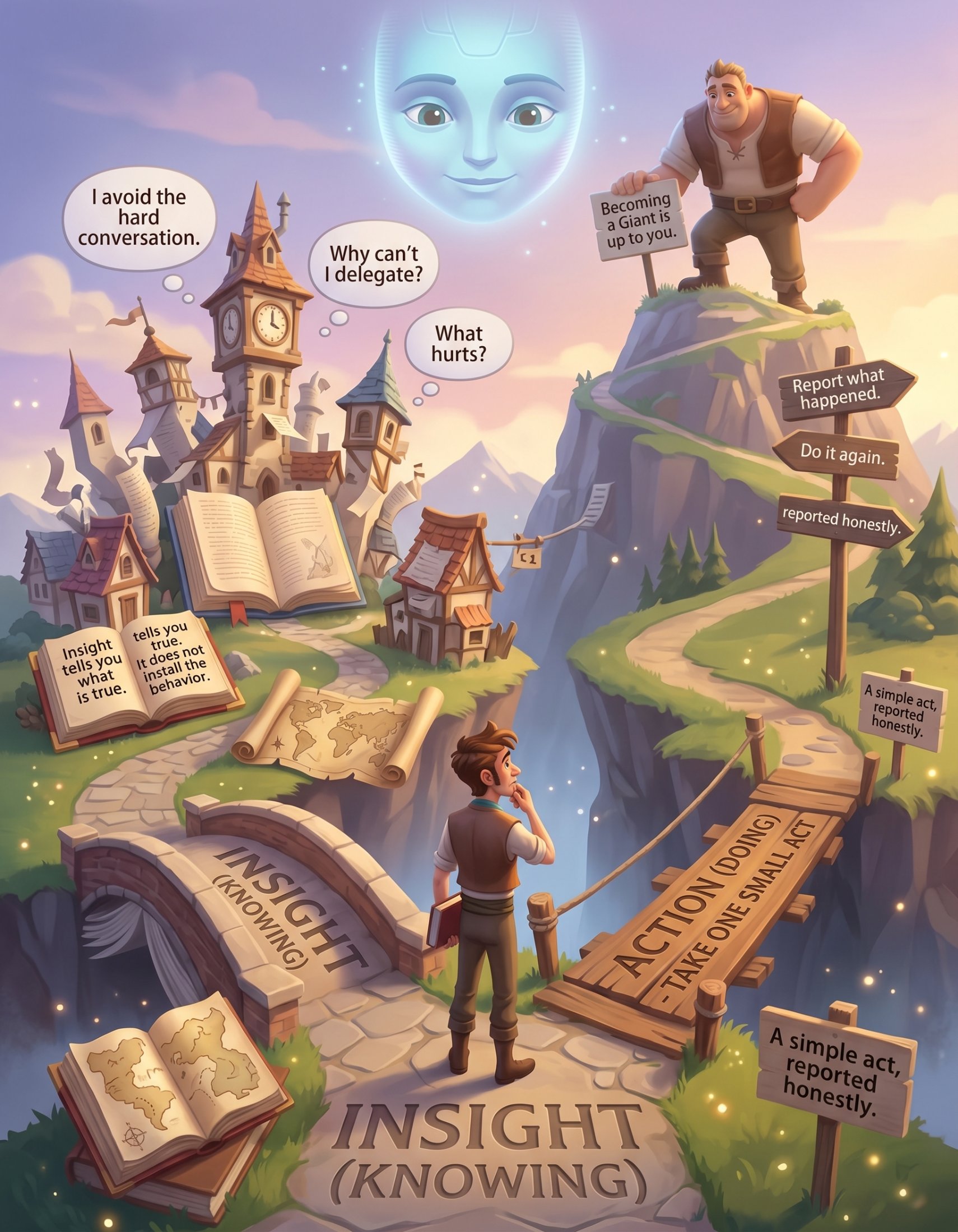
If you can explain your own pattern to a stranger in two sentences — and you're still living inside it — you don't have a discipline problem. You have a knowing-doing gap, and it runs on different machinery than willpower does. Insight tells you what's true. It does not install the behavior. Closing that gap takes a different kind of practice than reading one more book or trying harder on Monday.
Key takeaways:
This is one of the most common things a capable, high-functioning adult says about their own life — and it sounds like a contradiction, but it isn't one. You can hold accurate knowledge about your pattern (you overwork, you avoid the hard conversation, you undercharge, you say yes when you mean no) and still watch yourself do the same thing next Tuesday. That's because understanding a pattern and running a pattern are two different operations. One lives in your explanation of yourself. The other lives in what you actually do under pressure, on autopilot, when nobody's watching. The 12 Journeys framework names this directly: you don't have a discipline problem, you have an identity problem — the pattern is doing exactly what it's identity-wired to do, and no amount of additional understanding changes what it's wired to do.
If insight were the fix, the people most stuck would be the people who've read the least. In practice it's often the opposite — the Stuck Achiever has read the books, named the pattern, and can explain it in detail. The brand's own shorthand for this is blunt: insight is cheap, behavior is not. Knowing why you undercharge, why you avoid the conversation, why you take on everyone else's problem — none of that is the missing piece, because the knowing was never the bottleneck. The bottleneck is that nothing has asked the pattern to act differently in a moment that counts.
This shows up constantly in the roles where the Tribe does its sharpest work. A sales manager promoted for selling, now stuck leading a team, can tell you exactly why they keep doing the work themselves instead of delegating it — and still do the work themselves next week. A top producer who knows, in detail, why they're afraid to raise their price can still quote the old number on the next call. Why High Performers Can't Raise Their Prices walks through exactly this version of the gap in pricing conversations — the knowing was never in question, the acting was.
Inside the 12 Journeys, closing the gap isn't a mindset shift you talk yourself into — it's a sequence of small, real, reported acts.
If you want the mechanics of how the repeated-act structure itself works, The RIPPLE Method breaks down how small, repeated acts are sequenced inside the framework. And if the idea of an AI guide handling this alone sounds thin, Why Hybrid Coaching Beats Pure AI is worth reading on exactly what Rimi does — and doesn't — do in this process.
If you're looking for one more framework to understand yourself better, this will feel thin — that's not what it's built to do. If you're tired of explaining your pattern accurately and ready to take one real act and report on it honestly, including the falls, that's the actual work. Getting Started on the 12 Journeys walks through what the first week of that actually looks like.
Because knowing and doing are separate operations. Your explanation of your pattern lives in your understanding of yourself; the pattern itself runs on autopilot, wired to your identity. More accurate understanding doesn't rewire what the pattern does by default — only a different, repeated act does.
No. Trying to muscle through a pattern with willpower is, in the 12 Journeys framework, treated as exactly the wrong move — the pattern isn't a failure of effort, it's identity running on autopilot. Naming and tracing it, not gritting your teeth against it, is the actual work.
Insight is being able to explain your pattern. Action is Giant Crossings — one real, planned, reported act in the world, including honest reporting when it doesn't go as planned. The framework measures the act, not the explanation.
Rimi runs the daily check-ins and teach-back checkpoints that keep the pattern visible day to day, but Rimi's own stated role is to teach what he knows — becoming a Giant is up to you. The acting still has to be yours.
Start with Journey 1, which is built around noticing the pattern itself before you try to change it. From there, Giant Crossings gives you the small, real act — and a place to report what happened, falls included.
Start free — 30 days of All-Access, no card: all 12 journeys, Rimi, the Mirror, and the full Giant Crossings game are open from day one.
The clearest sign you need coaching: you understand the problem, you know what to do, and you still don't do it.

Powerlessness isn't the absence of control—it's the belief that your actions don't matter. You can have options and still feel trapped by them.

You set the plan. You know the plan. And somewhere between knowing it and doing it, you find yourself scrolling, snapping at someone who didn't deserve…
Feeling lost at 40 isn't a productivity problem—it's an identity problem. Here's why the pattern breaks when you rebuild who you actually are.

Your first 48 hours in the Tribe: start your journey, introduce yourself, meet the community. Everything's unlocked free for 30 days—here's how to.