Journey 12 · Legacy
A Meaningful Life and a Happy One Can Differ
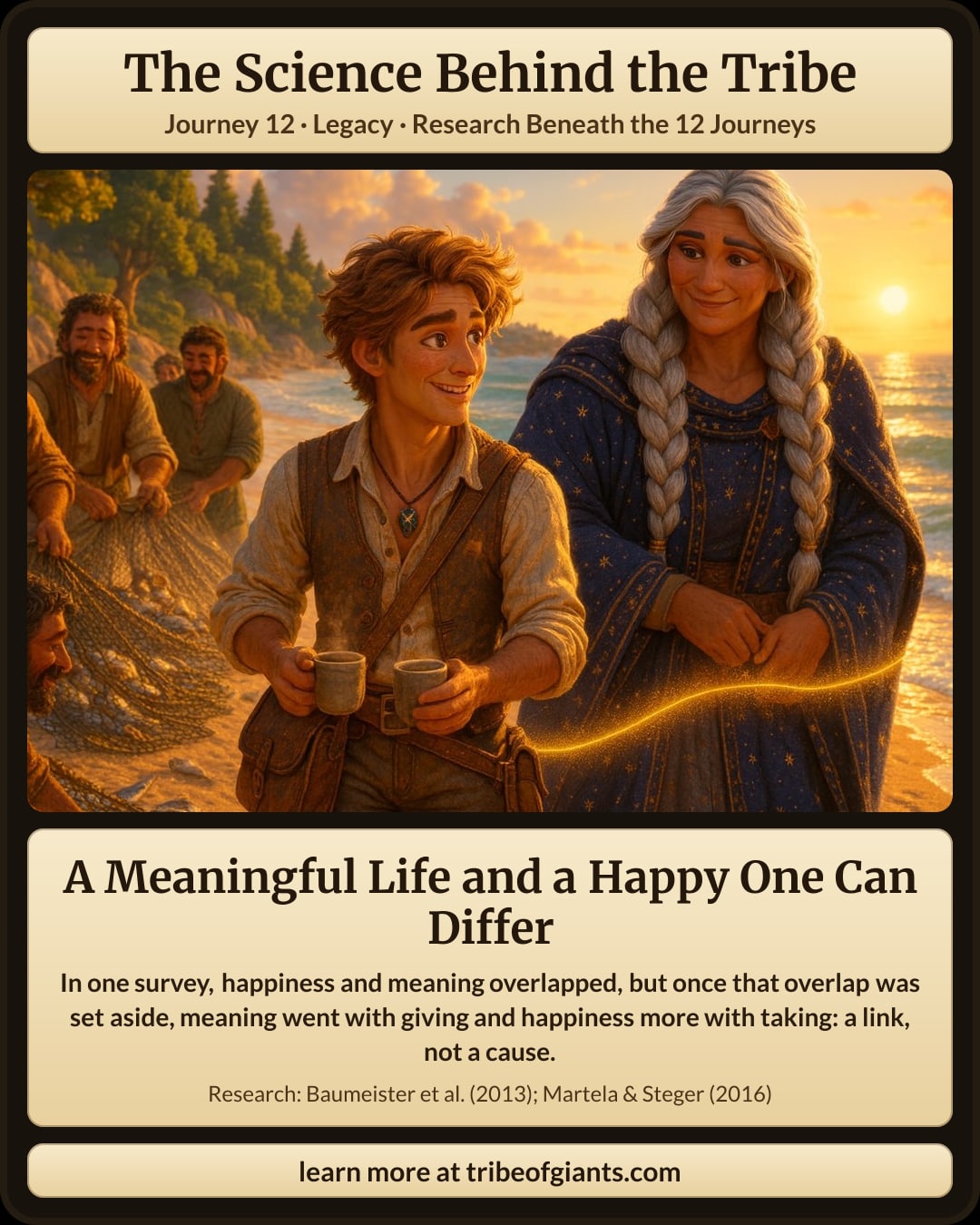
In one survey, happiness and meaning overlapped, but once that overlap was set aside, meaning went with giving and happiness more with taking: a link, not a cause.
Baumeister and colleagues surveyed several hundred US adults about how happy and how meaningful their lives felt. The two overlapped. Once the researchers set that overlap aside, meaningfulness went with being a giver and with linking past, present and future, while happiness went more with being a taker and with the present moment.
This is one survey, and it’s correlational: it shows what went together in these data, not that taking makes anyone happier or that givers are always happier. In a separate paper on what meaning is, Martela and Steger split it into three strands: coherence (life makes sense), purpose (it is heading somewhere) and significance (it matters).
Journey 12, Legacy, guided by Zakiya, sits on the meaning side of that line, and in the same survey, meaning also went with more worry, not less. Think of a day that felt meaningful to you, even a hard one: what were you giving?
The research
Growing evidence Real research that's still building — results are promising and still being tested.
- Baumeister, R. F., Vohs, K. D., Aaker, J. L., & Garbinsky, E. N. (2013). Some key differences between a happy life and a meaningful life. The Journal of Positive Psychology, 8(6), 505–516.
- Martela, F., & Steger, M. F. (2016). The three meanings of meaning in life: Distinguishing coherence, purpose, and significance. The Journal of Positive Psychology, 11(5), 531–545.
A free account for life, with All-Access free for your first 30 days. No card.
Join free