Journey 12 · Legacy
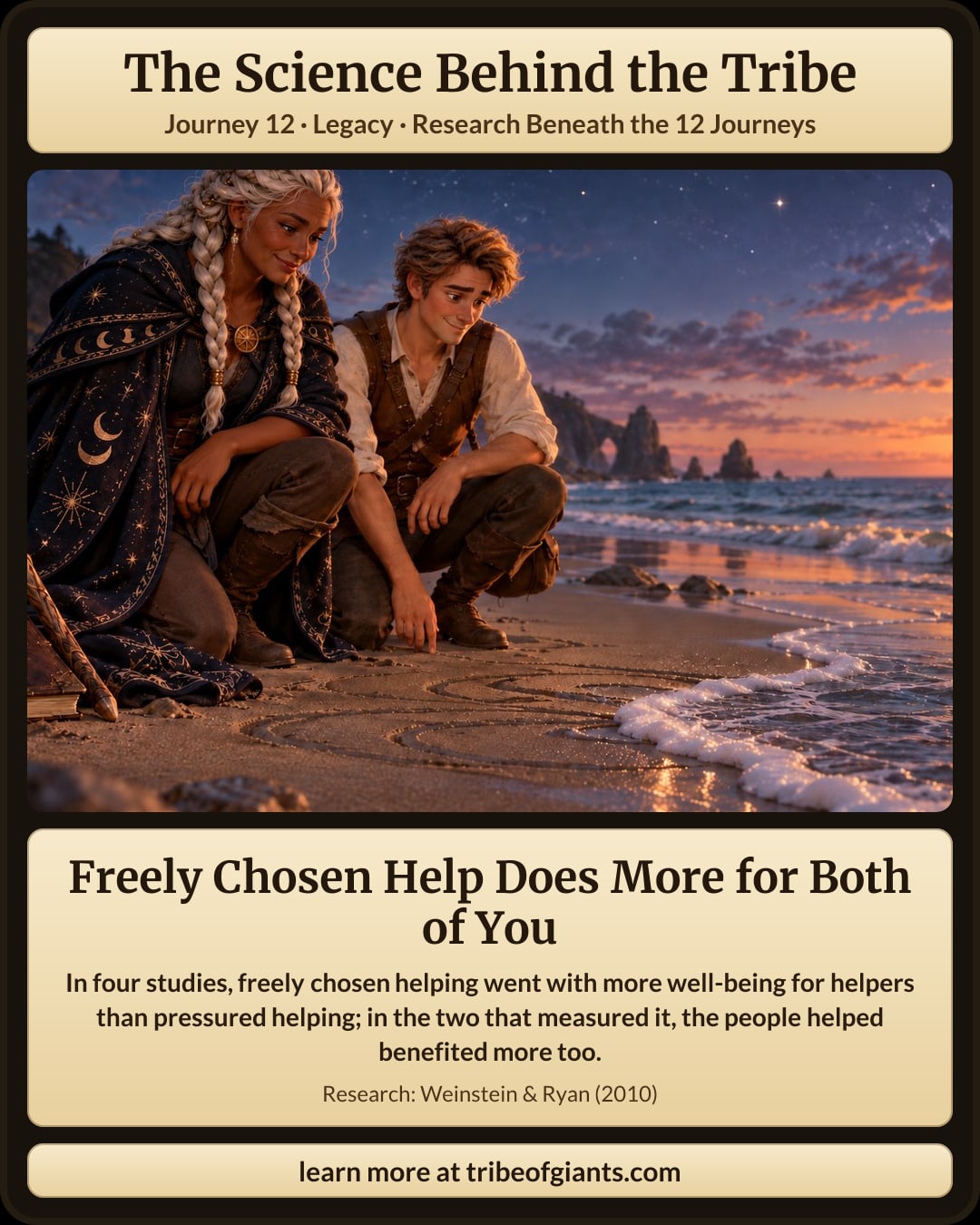
Freely Chosen Help Does More for Both of You
In four studies, freely chosen helping went with more well-being for helpers than pressured helping; in the two that measured it, the people helped benefited more too.
Weinstein and Ryan compared help people chose freely with help given under pressure or out of obligation. In four studies, one of them a daily diary, freely chosen helping went with more well-being for the helper than pressured helping did. In the two studies that also measured the person being helped, that person benefited more too.
So the word freely seems to be doing real work. That doesn’t make help you felt pushed into worthless. What the research points to is that choosing it freely changes what helping does for you, and, where it was measured, for the person you help.
In Journey 12, Legacy, guided by Zakiya, one practice asks you to give once without tracking whether it lands or comes back to you, which is meant to keep the act chosen rather than owed. What could you give this week simply because you want to?
The research
Strong evidence Replicated findings and meta-analyses.
- Weinstein, N., & Ryan, R. M. (2010). When helping helps: Autonomous motivation for prosocial behavior and its influence on well-being for the helper and recipient. Journal of Personality and Social Psychology, 98(2), 222–244.
A free account for life, with All-Access free for your first 30 days. No card.
Join free