Journey 12 · Legacy
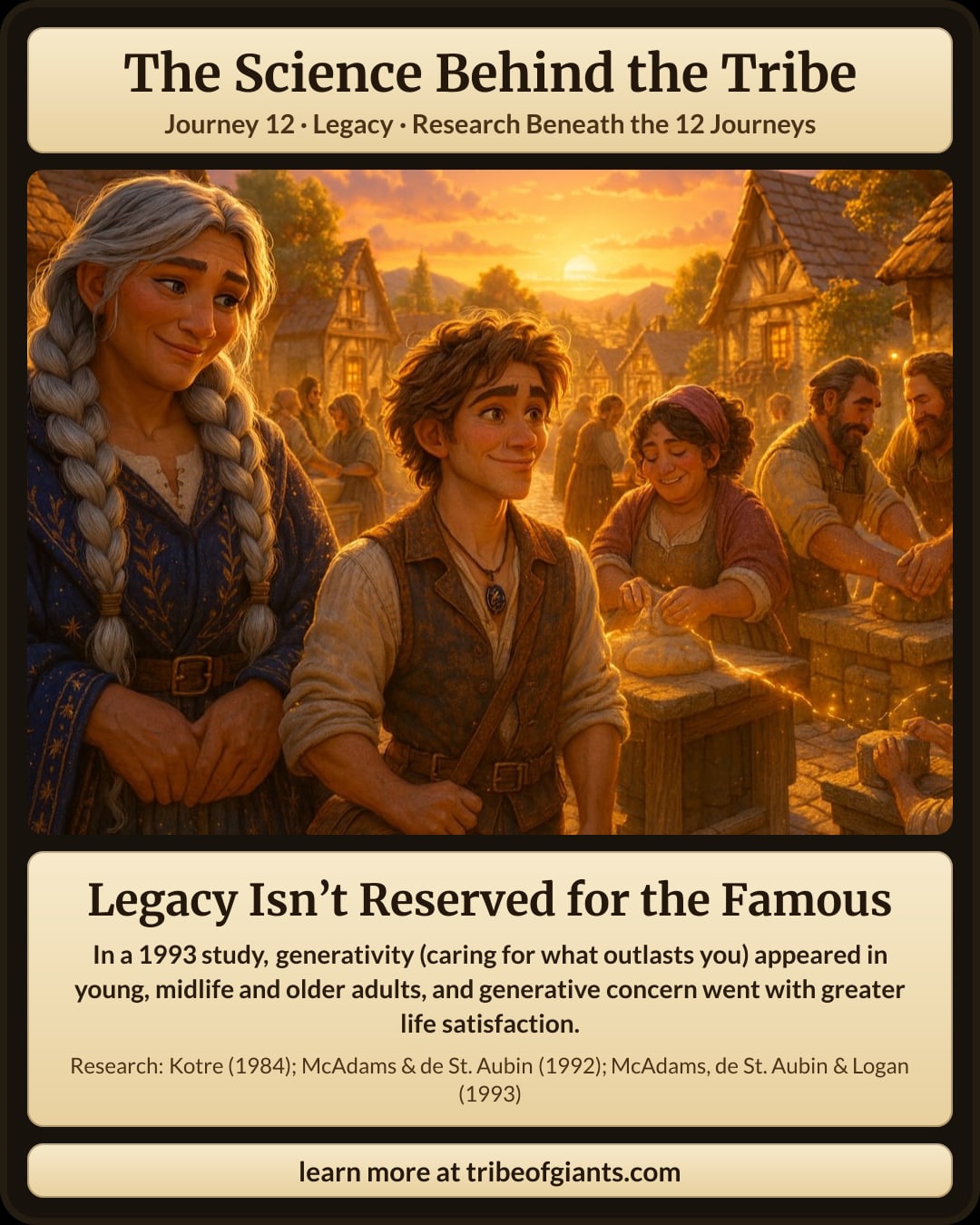
Legacy Isn’t Reserved for the Famous
In a 1993 study, generativity (caring for what outlasts you) appeared in young, midlife and older adults, and generative concern went with greater life satisfaction.
Psychologists call caring for what outlasts you generativity. McAdams and de St. Aubin developed a way to measure it in ordinary people, and a 1993 study by McAdams and colleagues found it, at differing levels, in young, midlife and older adults. In that study, generative concern went with greater life satisfaction.
John Kotre described four forms generativity can take: biological, parental, technical and cultural, from raising the next generation to teaching a skill or handing down a way of seeing. How far a legacy reaches differs from one life to the next. And the 1993 study found that generative concern and life satisfaction go together, not that one causes the other.
Journey 12, Legacy, guided by Zakiya, starts from ordinary ripples (a word, a habit of care) rather than monuments. Who carries something today that you once taught them?
The research
Strong evidence Replicated findings and meta-analyses.
- Kotre, J. (1984). Outliving the self: Generativity and the interpretation of lives. Johns Hopkins University Press.
- McAdams, D. P., & de St. Aubin, E. (1992). A theory of generativity and its assessment through self-report, behavioral acts, and narrative themes in autobiography. Journal of Personality and Social Psychology, 62(6), 1003–1015.
- McAdams, D. P., de St. Aubin, E., & Logan, R. L. (1993). Generativity among young, midlife, and older adults. Psychology and Aging, 8(2), 221–230.
A free account for life, with All-Access free for your first 30 days. No card.
Join free