Journey 12 · Legacy
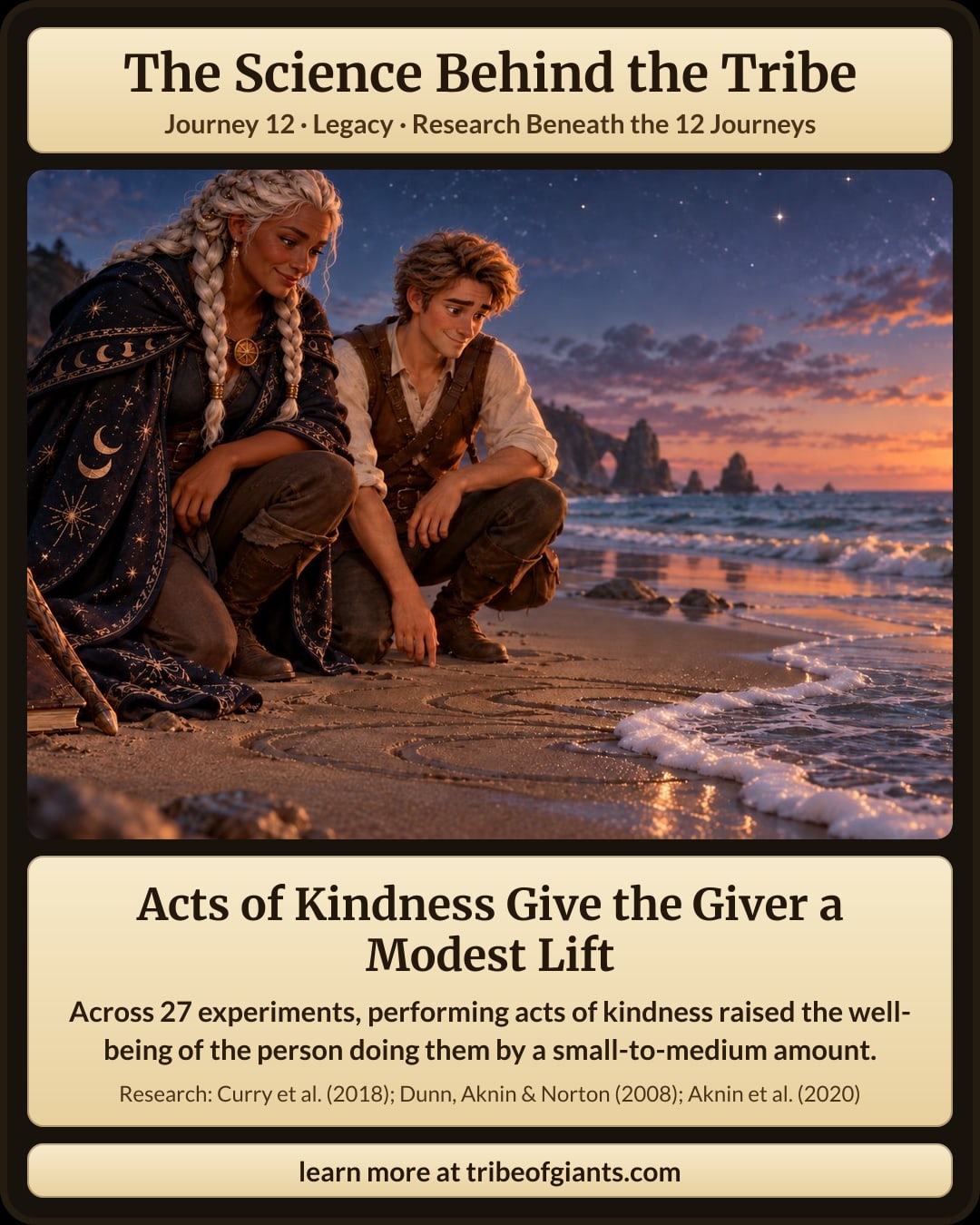
Acts of Kindness Give the Giver a Modest Lift
Across 27 experiments, performing acts of kindness raised the well-being of the person doing them by a small-to-medium amount.
Curry and colleagues pooled 27 experiments in which people performed acts of kindness. On average, the kindness raised the well-being of the person doing it by a small-to-medium amount (δ = 0.28). Separately, Dunn, Aknin and Norton found that spending money on others lifted people’s happiness more than spending it on themselves; a later preregistered replication found it in one experiment, a small effect in another and no difference in a third.
That is the honest size of it: real, but modest. For spending on others, the replication found the size depended on how the study was run. So don’t expect fireworks, and more kindness isn’t automatically better.
Journey 12, Legacy, guided by Zakiya, puts this to work as a daily seed: one small, freely given act, hung on something you already do and small enough to plant even on a bad day. What would tomorrow’s be?
The research
Strong evidence Replicated findings and meta-analyses.
- Curry, O. S., Rowland, L. A., Van Lissa, C. J., Zlotowitz, S., McAlaney, J., & Whitehouse, H. (2018). Happy to help? A systematic review and meta-analysis of the effects of performing acts of kindness on the well-being of the actor. Journal of Experimental Social Psychology, 76, 320–329.
- Dunn, E. W., Aknin, L. B., & Norton, M. I. (2008). Spending money on others promotes happiness. Science, 319(5870), 1687–1688.
- Aknin, L. B., Dunn, E. W., Proulx, J., Lok, I., & Norton, M. I. (2020). Does spending money on others promote happiness?: A registered replication report. Journal of Personality and Social Psychology, 119(2), e15–e26.
A free account for life, with All-Access free for your first 30 days. No card.
Join free