

If-Then Planning Examples for People Who Hate Rigid Routines
If-then planning examples for people who hate rigid routines — real trigger-and-response plans for work, relationships, health, and overthinking.
The Tribe of Giants · November 6, 2026

An if-then plan works because of its shape, not its content: a single sentence — "If [cue], then I will [action]" — that tells your brain exactly what to do the moment a specific moment arrives, so you don't have to decide in the moment you're least able to decide well. You don't need a new routine, a tracker, or a system. You need one sentence, decided in advance, for one moment that usually beats you.
If you've tried habit trackers, morning routines, and 30-day challenges and dropped all of them by week two, you're not a discipline case. You're a person who was handed the wrong tool. A routine asks you to repeat a whole structure, every day, forever. An if-then plan asks you to decide one thing, once, for one moment — and then get out of your own way.
Strip away the self-help packaging and an if-then plan is a sentence with two parts: a cue and a response.
That's the whole plan. Not a morning stack, not a checklist, not a 90-day protocol. One sentence, decided while you're calm, for the moment you won't be calm.
Here's the part people miss: an if-then plan isn't a discipline tool. It's a recognition tool. The sentence does the noticing for you, so that when the cue shows up — the inbox, the second glass, the silence after your kid slams the door — you're not standing there deciding from scratch. You already decided. You're just executing a plan you already trusted yourself with.
That's why it works for people who hate structure. You're not building a system you have to maintain. You're writing one sentence you only have to remember in one moment. The form carries the weight — not your motivation, not your mood that day, not whether you slept well.
This is also why "just try harder" never held: insight is cheap, behavior is not. Knowing your pattern was never the missing piece. A plan for the exact moment the pattern shows up is.
Here's the mad-lib. Fill in your own blanks — nothing else required:
"If ___, then I will ___."
Example: "If I feel the urge to check my phone at 11pm, then I will put it in the kitchen and read one page instead."
Notice what's missing: no app, no streak counter, no seven-day plan. Just the cue you already know by heart, and the one small, real act you're choosing instead — a plank, not an overhaul.
Pick the moment that usually trips you up. Decide now, while you're calm, what you'll do instead. That's the entire exercise.
Sometimes an if-then plan works for a week and then quietly stops. Usually it's not the sentence that failed — it's that the "then" no longer fits the real obstacle. You wrote a plan for a cue you could control, but the obstacle underneath it is something you can't change: a work situation, a person, a circumstance that isn't going anywhere.
When that happens, the plan needs a different partner. This is where accepting what you can't change comes in — not as a replacement for the plan, but as the thing that makes the plan honest again. You stop writing "then" statements for a problem you can't act your way out of, and you write one for what you can actually control inside it.
If you're not sure what the real cue is in the first place — the thing running underneath the behavior you keep trying to change — that's worth sitting with on its own. Seeing the patterns that run without your permission is the first step most people skip, and it's why the same if-then plan can fail for one person and hold for another.
Inside the Tribe, this isn't a worksheet you fill out once and forget. You open your check-in and talk the plan through with Rimi, your AI guide — he won't hand you a script, he'll help you get specific about the cue and the move, then he's there the next day to ask how it actually went, falls included. As Rimi puts it: "I'll teach you what I know—but becoming a Giant is up to you."
That's the difference between a sentence you write once and a plan that actually holds: someone asking about it tomorrow.
Join free — a free account for life, with All-Access free for your first 30 days, no card. Open a check-in, write your one sentence, and see what moves this week.
A habit asks you to repeat a whole routine every day until it sticks. An if-then plan asks you to decide one response, once, for one specific moment — it's a single sentence, not a system you have to maintain.
No. Pick the one moment that trips you up most — the cue you could already describe to a stranger — and write one plan for it. One sentence, one week, see what moves, rather than a list of plans for every pattern at once.
Usually the "then" no longer matches the real obstacle — the cue is still showing up, but what's underneath it is something you can't change through sheer action, like a work situation or another person. That's when the plan needs pairing with accepting what you can't change, not more willpower.
Yes — the sentence itself works on its own. But most people hold a plan better when someone asks how it went the next day, which is what the daily check-in with Rimi is built for.
👉 Join free — a free account for life, with All-Access free for your first 30 days
Free, by email
Where this path starts, what changes along it, and one thing you can do today. Then four short letters over two weeks.
If-then planning examples for people who hate rigid routines — real trigger-and-response plans for work, relationships, health, and overthinking.
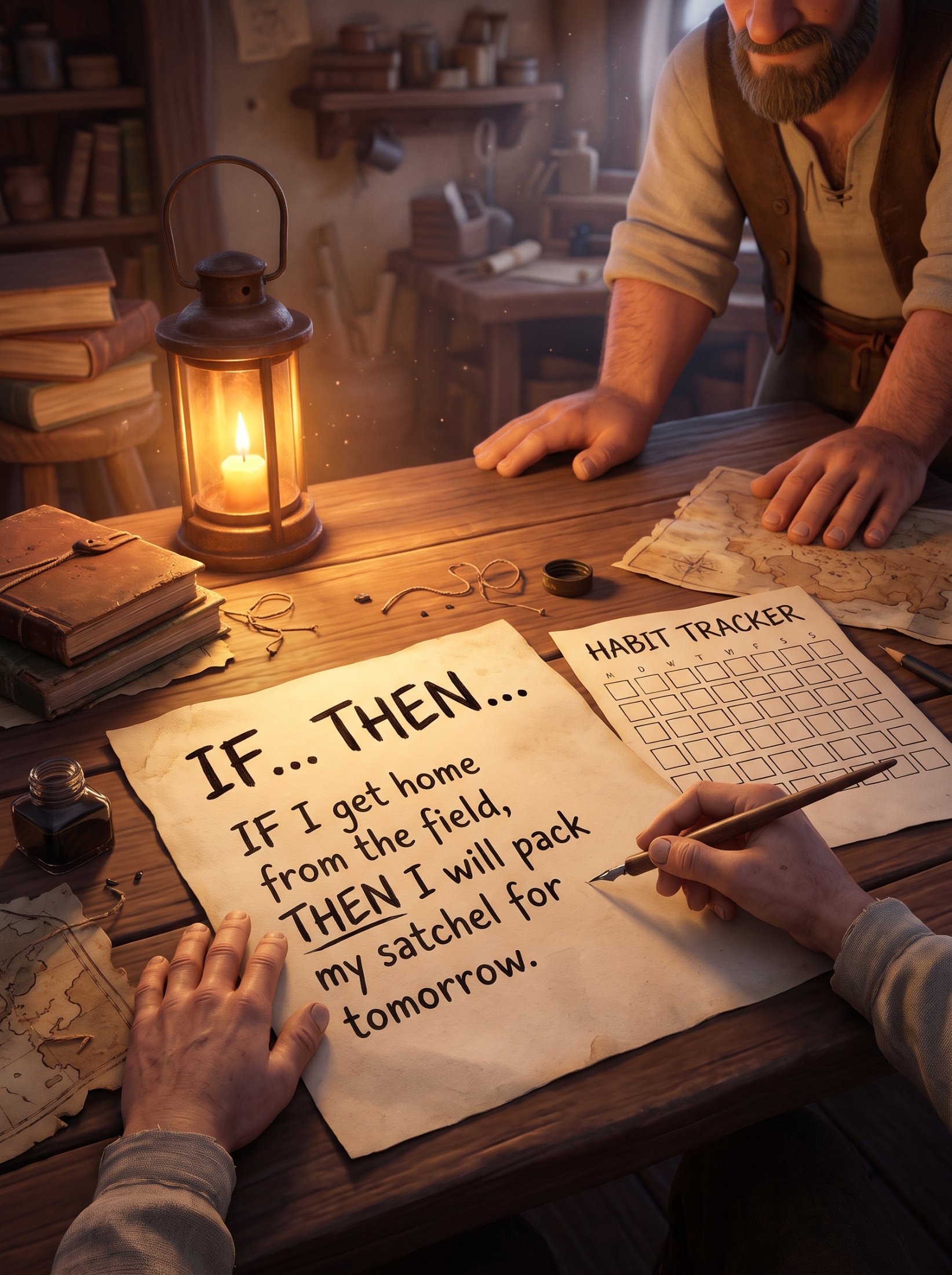
Habit trackers measure what you did. If-then plans pre-decide what you'll do when the real trigger hits. Three scenarios show the swap.

Stuck on repeat at work? Run this 8-question self-check to spot the autopilot loop, name the pattern, and take one real step out this week now.

Seven concrete scarcity mindset examples at work — hoarding credit, over-negotiating, panic at change — what each one protects and what it costs you.

A practical guide to what to do when you feel powerless at work — a bad boss, being passed over, or no voice in decisions — with one concrete act for each.