

Why If-Then Plans Work (Even If You Hate Routines)
Why if-then plans work even if you hate routines: it's one sentence, not a system — the cue, the move, and why it sometimes needs the Acceptance journey.
The Tribe of Giants · November 4, 2026

If-then planning means deciding, in advance and while you're calm, exactly what you'll do the moment a specific trigger shows up — "if X happens, then I'll do Y" — so you're not making the decision in the heat of the moment. You don't need a color-coded schedule or a new morning routine to use it. You need one sentence, built around a moment that already trips you up.
TL;DR: An if-then plan is one line — a trigger and a response, decided ahead of time. It works without a rigid routine because it only fires when the trigger shows up; the rest of your day stays exactly as loose as you want it. Below are real examples across work, relationships, health, and the moments that quietly derail people the most, plus how to build your own.
A routine asks you to do the same thing at the same time, every day, whether the day calls for it or not. An if-then plan doesn't. It only activates when its trigger happens — so on the days the trigger never shows up, you've committed to nothing. That's the whole appeal for someone who's tried the rigid morning routine, the habit tracker, the 30-day challenge, and abandoned all three by week two.
You already know your pattern — you could explain it to a stranger. The part that's hard isn't knowing. It's what to do in the exact moment the old habit is the easy one. An if-then plan answers that one moment, nothing more.
Each of these is a single sentence you decide in advance. Swap in your own trigger and your own move — the structure is what matters.
Work and sales:
Relationships:
Health and energy:
Money and discipline:
Parenting and home:
The moment you keep overthinking:
None of these require you to change your whole day. They require you to decide, once, what happens at one moment — and then let the rest of your life stay exactly as unscheduled as it already is.
If you want help building one, the if-then plan builder walks you through naming the trigger and the move for your specific pattern.
An if-then plan is useful on its own, for one moment. It gets a lot more useful once you know which moment is actually worth planning for — which means seeing the pattern underneath the moment, not just the moment itself. That's the work behind why you keep repeating the same patterns: most people can't see their own trigger clearly because it's run on autopilot for years.
Inside the Tribe of Giants, this is part of daily practice, not a one-time trick. Rimi, the AI guide, is built for exactly this kind of check-in — you talk through the moment and the move with him, and he's there the next day to ask how it actually went, falls included. As the framework puts it: "I'll teach you what I know—but becoming a Giant is up to you." If the pattern you're planning around is the one where you're always the one holding everyone else together, the Nurture journey is built around exactly that.
You're not broken and you're not undisciplined. You're running a pattern you learned for good reasons, and an if-then plan is one small way to interrupt it without needing to overhaul your whole life to do it.
An if-then plan is a single sentence that pairs a specific trigger with a specific response, decided in advance — "if X happens, then I'll do Y." It works because the decision gets made ahead of time, while you're calm, instead of in the moment when the old habit is easiest.
A routine asks for the same action at the same time regardless of circumstance. An if-then plan only activates when its specific trigger occurs, so it fits people who've tried rigid schedules and dropped them — there's nothing to maintain on days the trigger doesn't show up.
Yes, but start with one. The value of an if-then plan comes from how specific and well-rehearsed the trigger and response are; stacking several at once usually means none of them get decided clearly enough to actually fire when the moment hits.
That's worth reporting honestly, not hiding. Look at what the actual trigger was in the moment — it's often slightly different from what you planned for — and rewrite the if-then sentence to match the real moment more precisely.
No — a sentence on paper works. The if-then plan builder exists for people who want help naming the trigger and the move clearly, but the method itself is just the sentence.
👉 Join free — a free account for life, with All-Access free for your first 30 days
Free, by email
Where this path starts, what changes along it, and one thing you can do today. Then four short letters over two weeks.
Why if-then plans work even if you hate routines: it's one sentence, not a system — the cue, the move, and why it sometimes needs the Acceptance journey.

Seven concrete scarcity mindset examples at work — hoarding credit, over-negotiating, panic at change — what each one protects and what it costs you.
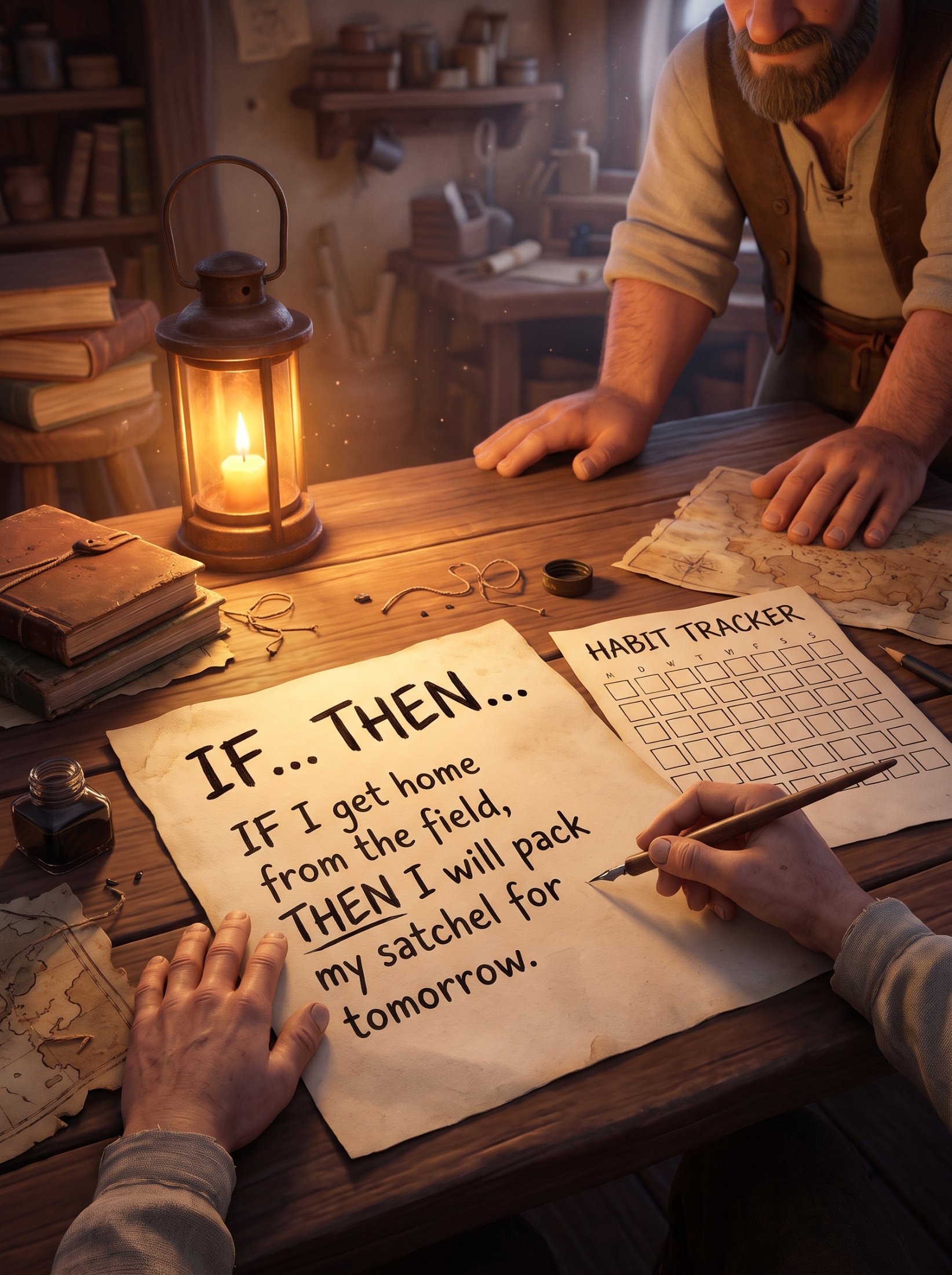
Habit trackers measure what you did. If-then plans pre-decide what you'll do when the real trigger hits. Three scenarios show the swap.

Always the strong one? Learn how to ask for help without guilt — a real script, not just advice to "just ask," built for people who never practice this.

There's a moment most people hit when they join the Tribe where they realize something: an AI guide and a living community aren't the same…