

If-Then Planning Examples for People Who Hate Rigid Routines
If-then planning examples for people who hate rigid routines — real trigger-and-response plans for work, relationships, health, and overthinking.
The Tribe of Giants · November 10, 2026
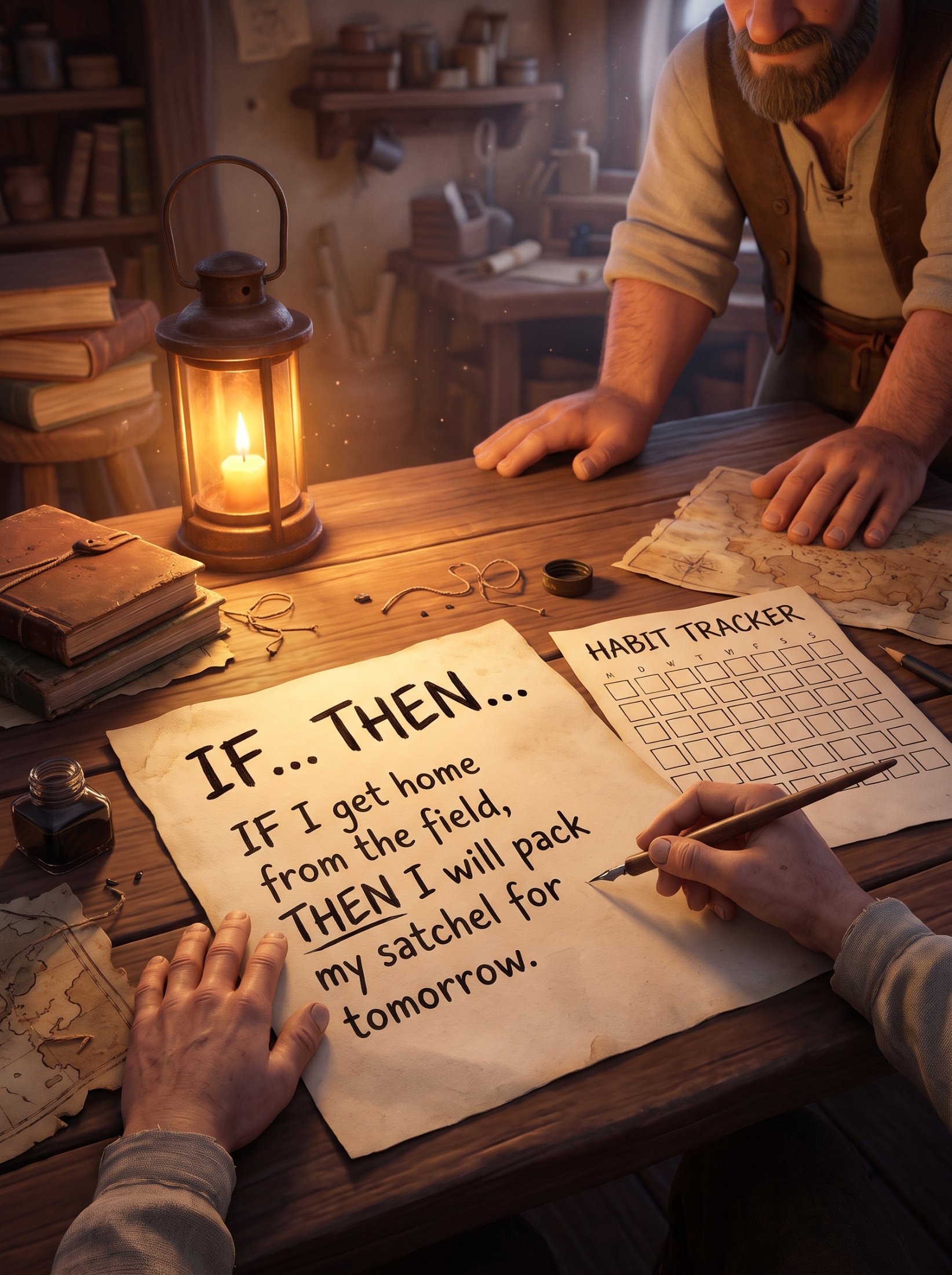
A habit tracker asks you to check a box after the fact. An if-then plan asks you to decide, in advance, exactly what you'll do the moment a specific trigger shows up — so there's no decision left to make when you're tired, stressed, or already mid-spiral. If you've quit three habit trackers this year, the problem probably isn't your follow-through. It's that a streak of empty boxes was never going to change what happens in the actual moment you're tempted to skip.
TL;DR: Habit trackers measure whether you did the thing. If-then plans pre-decide what you'll do when a specific cue shows up, so you're not relying on willpower in the moment. Format: "WHEN [trigger], I WILL [small action]." Below are three real-world scenarios showing the swap.
A habit tracker is a scoreboard. It's useful for noticing a pattern after the fact, but it doesn't help you in the ten seconds where the pattern is actually deciding what you do next. By the time you're opening the app to mark a missed day, the moment that mattered — the scroll instead of the walk, the snooze instead of the gym — already happened. The tracker records the loss. It doesn't interrupt it.
That's the gap an if-then plan is built to close. Instead of tracking whether you did the thing, you write down the exact cue that comes right before you don't — and the one small move you'll make instead, decided ahead of time.
Tracker version: a daily checkbox for "made 10 calls." He missed Tuesday, missed Wednesday, deleted the app by Friday. If-then version: "WHEN I close my laptop after my last scheduled call, I WILL dial one more number before I stand up." The cue isn't "be disciplined about prospecting" — it's one exact, visible moment in his day he can actually catch.
Tracker version: a habit app streak for "patient parenting," reset to zero more nights than not. If-then version: "WHEN I feel my jaw tighten and my voice start to rise, I WILL put my hand flat on the counter and take one breath before I say anything." The trigger is a physical sensation she can actually notice in real time — not a category like "stay calm," which is too late to catch once it's already failed.
Tracker version: a weekly goal, "have one direct conversation," that rolled over unchecked for a month. If-then version: "WHEN I notice I'm rehearsing an excuse to push the meeting to next week, I WILL send the calendar invite right then, before I close the thought." The cue is the excuse itself — the exact moment the avoidance pattern shows up — not a vague weekly intention.
Notice what's different in all three: the tracker measured an outcome at the end of the day. The if-then plan names a moment that happens during the day, one specific enough to actually notice when it's live.
A to-do list, and most trackers underneath it, assume the hard part is remembering. For most people stuck in a pattern, remembering isn't the problem — they can describe the pattern perfectly to a friend. The hard part is catching the trigger before the pattern runs. That's a different skill than discipline, and it's the one a checkbox can't teach you.
This is close to what the Tribe of Giants' Awareness journey is built around — Lemeki, the guide for that journey, teaches seeing what's running before you react to it. An if-then plan only works once you can actually notice the real cue, which is a narrower, earlier skill than most people think they're missing. Before that, most people are still working one layer back, in what the framework calls the Non-Consciousness journey — noticing that a reaction is even running on autopilot in the first place.
If you've already read about the mechanism and it still hasn't moved anything, that's worth naming honestly: why you can't follow through usually isn't about knowing the pattern. It's about catching it live.
This is also where a tracker and an if-then plan can work together, not against each other: once you've found the real trigger, a simple daily check-in on whether you caught it — not whether you were "good" — is useful. That's different from a streak counter measuring an outcome you can't control in the moment.
Inside the Tribe, this is what the daily check-in with Rimi, the AI guide, is for — not scoring you, but asking the one honest question each day: did you catch the moment, or not. As Rimi puts it, "I'll teach you what I know—but becoming a Giant is up to you." The plan is yours to catch; the check-in just keeps you honest about it.
If you want to build the first version of yours, the if-then plan builder walks you through naming the real trigger instead of the one you can only describe afterward.
A habit tracker records whether you did something, usually at the end of the day, after the moment that mattered has already passed. An if-then plan pre-decides the exact response to a specific trigger, so the decision is made before the moment arrives, not during it.
Most habit trackers measure an outcome without addressing the moment where the pattern actually gets decided. Once a day or two gets missed, the streak resets, the tracker starts to feel like another source of guilt, and people quit the app rather than rebuild the streak.
Yes — an if-then plan is triggered by a moment, not a time on a clock. "WHEN I notice my jaw tighten" can happen at any hour; the plan doesn't require a fixed routine, only a trigger specific enough to notice when it's live.
That usually means the trigger you named is one you can only describe afterward, not one you can catch in the moment. The fix is to rewrite the plan with an earlier, more physical, more specific cue — not to add more structure or abandon the plan entirely.
No — the plan only needs to be written down somewhere you'll see it before the moment hits, and reported honestly afterward. A notebook works; what matters is the specificity of the trigger, not the tool holding it.
If you're tired of resetting a streak and ready to try naming the actual moment instead, join free — a free account for life, with All-Access free for your first 30 days, no card. Keep All-Access afterward for $19 a month or $149 a year only if you want it.
👉 Join free — a free account for life, with All-Access free for your first 30 days
Free, by email
Where this path starts, what changes along it, and one thing you can do today. Then four short letters over two weeks.
If-then planning examples for people who hate rigid routines — real trigger-and-response plans for work, relationships, health, and overthinking.

An identity statement is "I'm someone who…" instead of "I will…". Learn how to write one, test it against a bad day, and make it stick.

Why if-then plans work even if you hate routines: it's one sentence, not a system — the cue, the move, and why it sometimes needs the Acceptance journey.

How to stop being the go-to person at work without damaging the team: a step-by-step boundary script, what to expect, and how to redirect instead of just.

Stuck on repeat at work? Run this 8-question self-check to spot the autopilot loop, name the pattern, and take one real step out this week now.