Legacy Letter Template Examples You Can Fill In Today
A fill-in-the-blank legacy letter template with starter prompts and examples for parents, partners, and leaders who don't know where to begin.
The Tribe of Giants · October 28, 2026
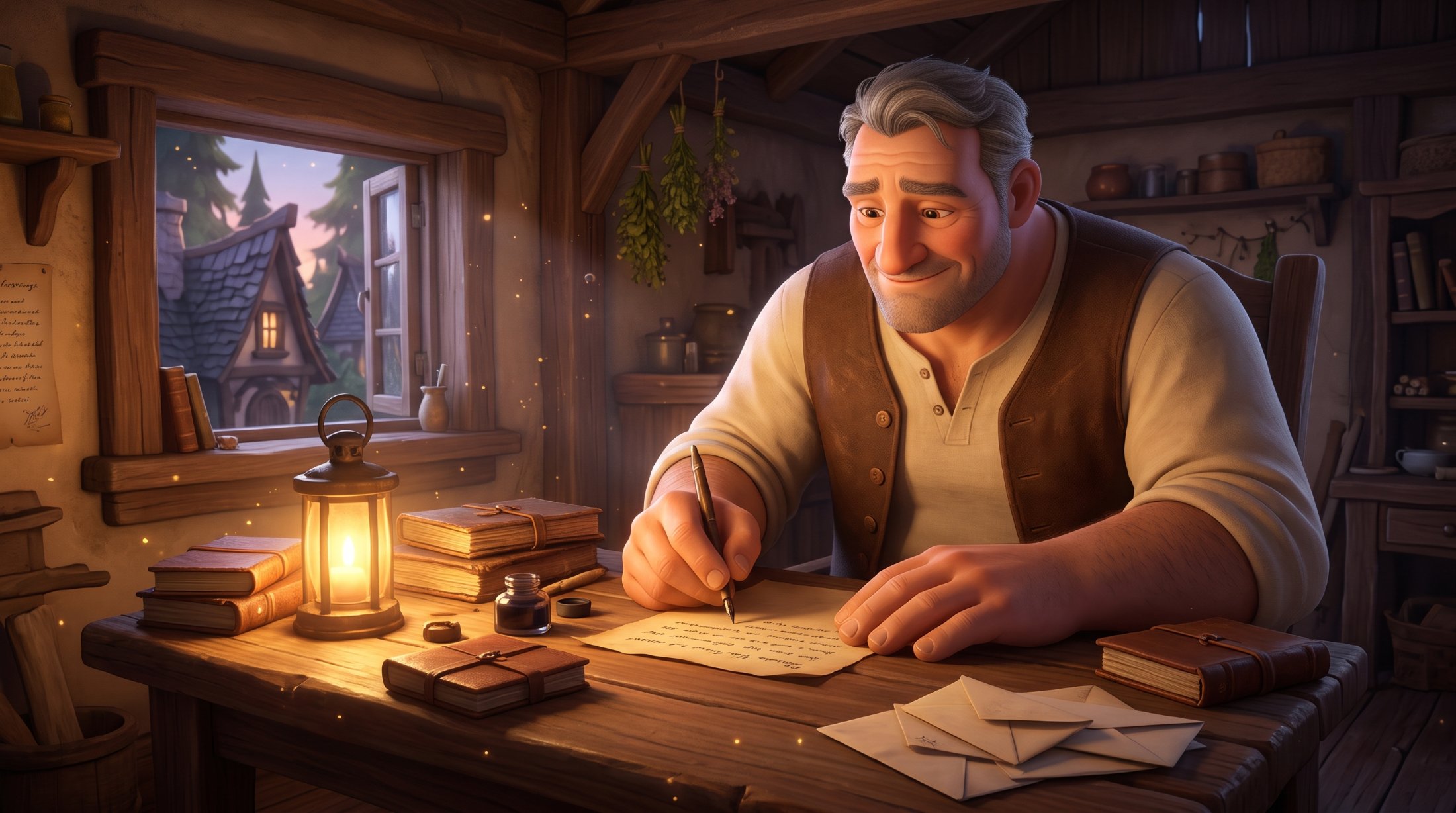
A legacy letter to your children is a written record of what you want them to carry after you're gone — not your assets, your heart. If you don't know what to say, start smaller than "my whole life's wisdom": start with one memory, one thing you want them to know was true about your love for them, and one hope. The three prompts below exist for exactly the moment you sit down, pen in hand, and freeze.
Most people who sit down to write a legacy letter stall at the same wall: they think they need to summarize a lifetime before they're allowed to say anything. That's backwards. In the 12 Journeys framework, the Legacy journey — the twelfth and final journey, guided by the character Zakiya, whose name means "pure, intelligent, remembered" — teaches that you don't have to be "healed" to begin leaving a legacy. Legacy can start right now, today, regardless of past actions or perceived imperfections. You are not writing from the mountaintop. You're writing from wherever you're standing.
That reframe matters because a legacy letter to your children isn't a performance of a finished life. It is not merely about what one leaves behind after their lifetime, but rather about intentionally living a purposeful life in the present moment that creates a meaningful, lasting impact. The letter is one more act of that present-tense living — not a verdict on the past.
Pick one. Write for ten minutes without editing. You can always write a second letter later — this one just has to be honest.
Write about one specific moment you knew you loved this child — not the general fact of loving them, the actual moment. Where were you standing? What did you notice about them? Children don't need "I always loved you" — it's too big to hold. They need the scene: the hospital room, the backseat of the car, the phone call at 2am. Specificity is what makes a legacy letter land as real instead of as a card.
Write about a pattern you carried — a worry, a habit of silence, a way you were hard on yourself or on them — and name, plainly, that you hope it stops with you. This is the hardest prompt and the most valuable one. You are not confessing to earn forgiveness. You are handing your child the one thing that actually changes a family line: the truth about what you were carrying, named out loud, so they don't have to inherit it quietly. This is what it means to leave behind more than you were given.
Write one sentence that starts with "I hope you…" and finish it with something about who they become, not what they achieve. Not "I hope you make partner" — "I hope you stay soft in a hard world," or "I hope you ask for help before you're desperate for it." This is the line they'll come back to. It's the closest thing to handing them a piece of the whole map of the 12 Journeys in a single sentence — the version of you that got there, speaking to the version of them that's still becoming.
Don't wait for a deathbed or a diagnosis. Give it now, on an ordinary Tuesday, or put it somewhere they'll find it later — a drawer, a safe, a note attached to a birthday card. A legacy letter doesn't need a ceremony. It needs to exist outside your head.
If this is the first time you've sat with a question this size, you're not alone in that — Journey 9 asks the same kind of question about your own life, not just what you want your kids to know, and it's worth sitting with what you actually want in life before you write to anyone else about it. And if what's surfacing as you write is less hope and more resentment or grief about what you didn't get — that's real too, and it's worth working through how to practice gratitude when life is hard before you try to write from a place you haven't reached yet.
This single letter is one page of a much bigger question — what you're building your whole life toward, who you want to be when your name is finally said after you've left a room. That's the work of the Legacy journey itself: not one letter, but a way of living now that makes the letter true.
A free Tribe of Giants account is free for life, no card, and comes with thirty days of full All-Access on top — every journey, Rimi, and the full Giant Crossings game — if you want to go further than one letter.
A will distributes property and is a legal document; a legacy letter has no legal weight and carries no instructions about money or belongings. A legacy letter to your children is personal and emotional — it tells them who you were, what you hoped for them, and what you want them to carry, not what they're owed.
No. You can write a legacy letter at any age and any stage of life — a new parent, someone in midlife, or anyone who has recently faced a loss or a turning point all have reason to write one now. Waiting for a "big enough" moment is often just another way of putting it off.
Start with the smallest true thing you can think of, not the biggest. Use one of the three prompts above — a specific memory, a pattern you hope ends with you, or a single sentence that starts with "I hope you…" — and let the rest of the letter follow from there.
Either is fine. Some people write one letter meant to be read once; others write a short letter every year and let it become a record over time. The point isn't the format — it's that the letter gets written and gets into your children's hands instead of staying a good intention.
👉 Join free — a free account for life, with All-Access free for your first 30 days
Free, by email
Where this path starts, what changes along it, and one thing you can do today. Then four short letters over two weeks.
A fill-in-the-blank legacy letter template with starter prompts and examples for parents, partners, and leaders who don't know where to begin.
One prompt, three minutes: how single-prompt journaling stops the what-if spiral before a big decision, with the exact questions to write and when to stop.
Gratitude journaling has become the standard answer for scarcity thinking. Write three good things. Feel the shift.
An identity statement is "I'm someone who…" instead of "I will…". Learn how to write one, test it against a bad day, and make it stick.
An if-then plan is how you actually keep promises to yourself — name the trigger, pre-decide the small act, and report the fall. Here's how to write one.