

How to Figure Out What to Do Next in Your Career
Never had career direction, not reinventing one? Here's a repeatable process to figure out what to do next in your career — plus where the Vision journey.
Pick the direction by testing each option against the person you're trying to become, not by comparing every feature on a list. Cut your options to two or three real contenders, picture what each future looks like a year in, and name the obstacle most likely to stop you. The option you'd still choose, obstacle and all, is your direction.
Why trust this answer: Written by Nicholas Townsend Smith, co-creator of the 12 Journeys framework and an executive life and business coach with an MPsy in Industrial/Organizational Psychology.
👉 Join free — a free account for life, with All-Access free for your first 30 days
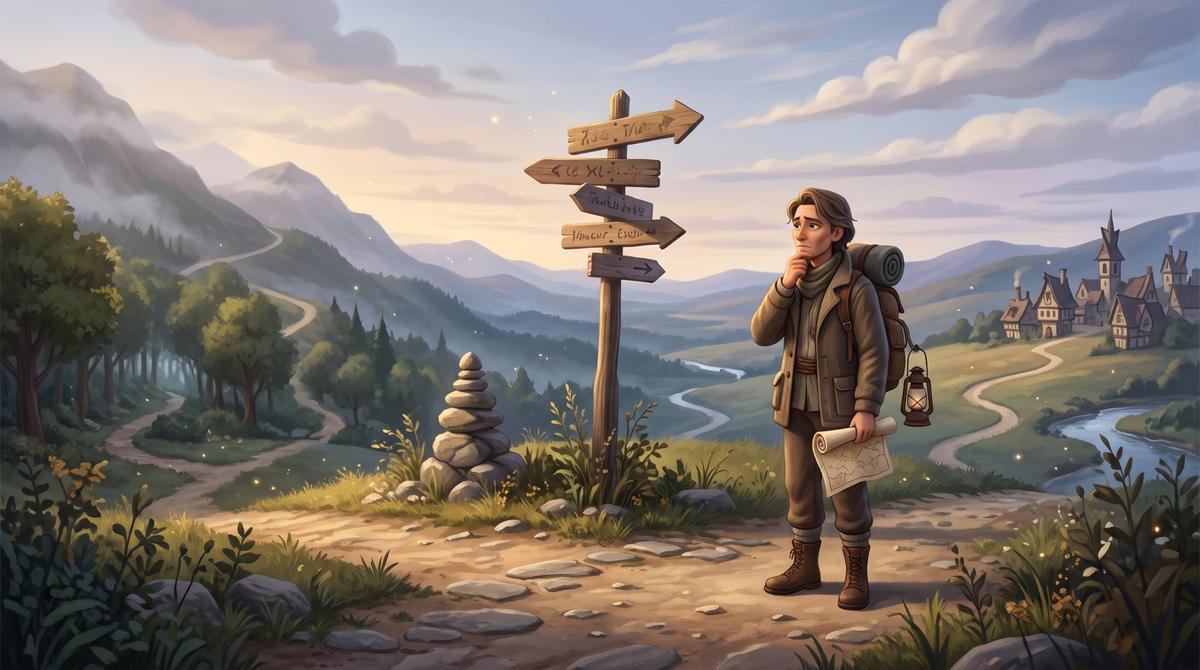
More options make it harder because your mind treats each one as a reason to keep comparing instead of a reason to commit. Three good paths forward can feel like safety, but in practice each one becomes an argument against the other two — you can always find a feature one option has that the others lack, and that feature becomes the reason to keep circling instead of choosing.
In the 12 Journeys framework, this is the territory of Journey 9 — Vision, guided by Drish. The journey's teaching is that vision isn't a list of acceptable futures, it's a specific, detailed future — what do I want in life? finding purpose again only becomes answerable once you stop holding every option open at once.
The first move is to cut your list before you compare it, not after. A list of five or six paths isn't five or six real choices — it's a way of avoiding a decision while feeling productive. Here's the walkthrough:
You narrow it by sorting for want instead of safety, because an option you chose out of fear tends to get less of your real effort even if you pick it. Go through your list and ask, for each one: did I write this down because I want it, or because it's the one nobody would question? The second kind rarely survives a year of actual effort — options you chose because they genuinely fit what you value tend to get more sustained effort and more real progress than options chosen to look safe or impressive, which is exactly what you want when you're betting a year of your life on a direction, as the research behind goals that are yours getting more effort lays out.
Picturing your future in detail changes the decision because a vivid, specific picture of what's ahead makes you more willing to choose the option that pays off later over the one that feels easier right now. In a study using a simple money-choice task, people who brought specific events from their own imagined future to mind — not vague ones, specific ones — chose the larger, later reward more often, and the more vividly they imagined it, the more their choice shifted, a pattern described in people who pictured their future chose more patiently. That's the same mechanism Journey 9 is built on: dreaming in enough detail that the future stops being a guess and starts acting like a memory you're walking toward.
There's a second piece worth knowing before decision day: imagining the win and then naming the obstacle in its way is also what carries your commitment through — when you expect to succeed, naming the obstacle first strengthens your follow-through, and when you don't expect to succeed, it doesn't, a finding laid out in dream first, then picture the obstacle. In practice: don't skip the obstacle step above to protect your enthusiasm. Naming it is what makes the choice stick.
If you still can't decide, you're not missing information — you're missing a way to tell the two futures apart, so build that comparison on paper instead of in your head. Lay the two options side by side on the same questions instead of letting them stay abstract:
| Question | Option A | Option B |
|---|---|---|
| What does a Tuesday look like in a year? | ||
| What's the specific obstacle this path hits? | ||
| What do I give up to take this path? | ||
| Who am I becoming if I choose this for three years, not one? | ||
| Which one would I pick if I had to explain my reasoning to someone I respect? |
If the table still comes out even, pick the option with the smaller obstacle and a real next act you can take this week. Certainty isn't coming before you move — the research behind writing about your best possible self found it reliably lifts optimism and positive expectations even without resolving which path is "right," a pattern found across a review of 29 studies on the exercise described in writing about your best possible self lifts optimism. Confidence tends to follow the decision, not precede it.
Illustrative example. Imagine a mechanic who owns her own shop, sitting on three real paths forward: take on a second location across town, bring in a junior mechanic and train him up, or stay exactly as she is and raise her prices instead. All three look reasonable on paper, and she's been turning the decision over in her head for months without landing on one.
She writes all three down, including the fourth option she'd been avoiding saying out loud — selling the shop and going to work for someone else for a while. She crosses that one off once she admits it's fear talking, not want. That leaves three. For each, she writes what a Tuesday looks like in a year: a second location means she's driving between two shops and barely touching a wrench herself; training a junior mechanic means slower months now and a shop that doesn't fully depend on her later; raising prices means losing a few long-time customers but keeping her days the same.
She names the obstacle for each — the cash to open a second bay, the patience to train someone slower than her, the awkward conversations with customers about price — and finds she'd still choose the training path even with its obstacle named plainly. That's the direction. The second location stays a maybe for a future year, not a reason to stall this one.
👉 Join free — a free account for life, with All-Access free for your first 30 days
Free, by email
Where this path starts, what changes along it, and one thing you can do today. Then four short letters over two weeks.
Never had career direction, not reinventing one? Here's a repeatable process to figure out what to do next in your career — plus where the Vision journey.
Powerlessness isn't the absence of control—it's the belief that your actions don't matter. You can have options and still feel trapped by them.
Three solo self-awareness exercises a leader can run in under two minutes before a 1:1 — no app, no coach, just three honest questions.
Stuck on repeat at work? Run this 8-question self-check to spot the autopilot loop, name the pattern, and take one real step out this week now.
Facing a career fork with no clear answer? A practical, step-by-step way to decide when the future is unclear — without waiting for certainty that isn't.