Journey 9 · Vision
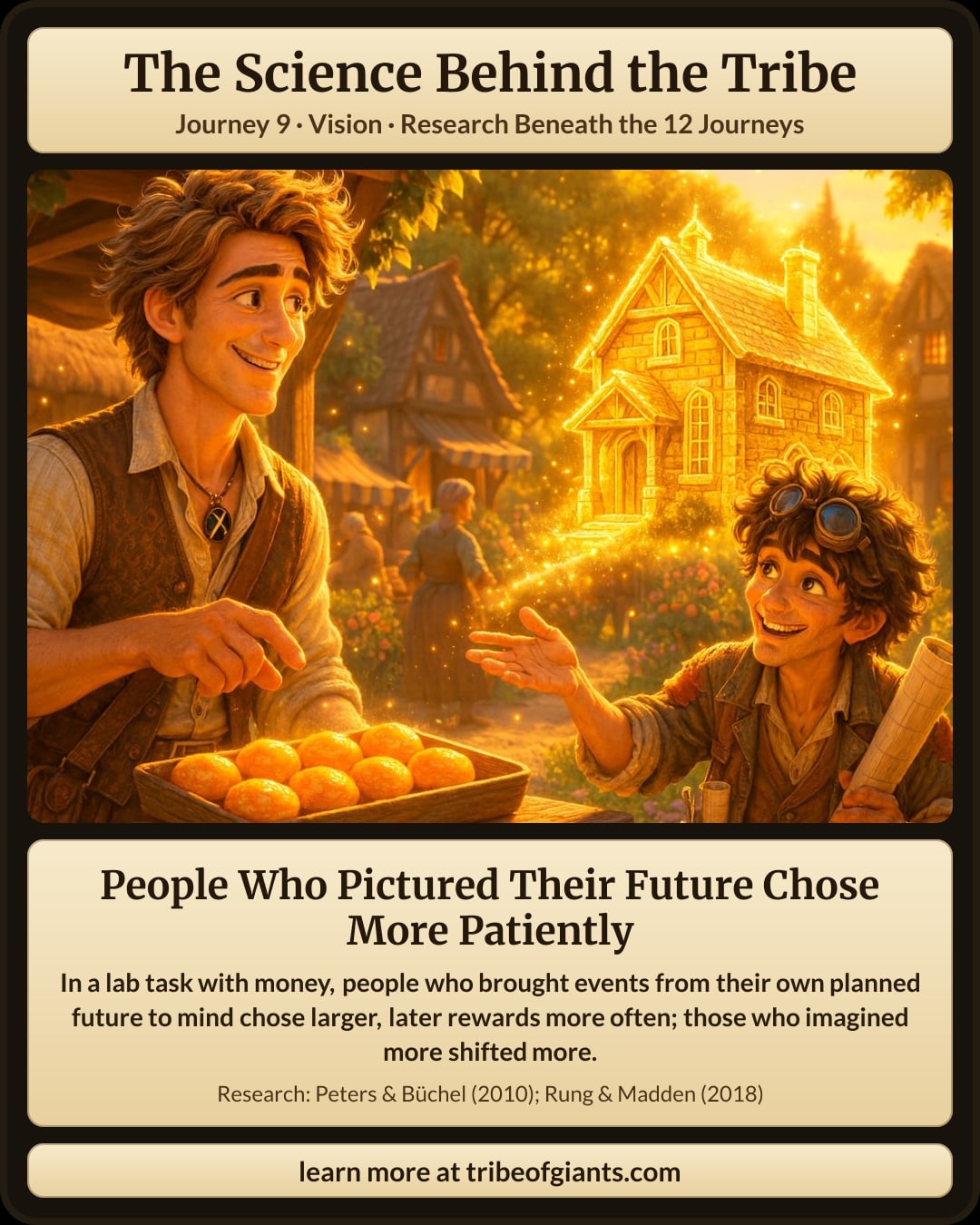
People Who Pictured Their Future Chose More Patiently
In a lab task with money, people who brought events from their own planned future to mind chose larger, later rewards more often; those who imagined more shifted more.
In a lab study by Peters and Büchel, people chose between smaller sums of money sooner and larger sums later. When they brought specific events from their own planned future to mind while choosing, they chose more patiently, and people who imagined those events more shifted more. A later review of 92 articles counts this kind of future thinking among the methods that reduce impatience in choices like these.
In plain terms, in these choices about money, bringing a specific future to mind tilted the choice toward later. It tilted the choice without guaranteeing it, and the study measured choices in the moment, not whether the effect lasts. The review's authors also say more research is needed to show how far these methods carry into everyday choices.
Journey 9, Vision, guided by Drish, gives a vision exactly this practical job: helping today's choice favor tomorrow. Think of it as a practice to try, not a switch you flip once. The next time you're weighing now against later, bring to mind one specific moment you're looking forward to, then choose. What does that moment look like?
The research
Strong evidence Replicated findings and meta-analyses.
- Peters, J., & Büchel, C. (2010). Episodic future thinking reduces reward delay discounting through an enhancement of prefrontal-mediotemporal interactions. Neuron, 66(1), 138–148.
- Rung, J. M., & Madden, G. J. (2018). Experimental reductions of delay discounting and impulsive choice: A systematic review and meta-analysis. Journal of Experimental Psychology: General, 147(9), 1349–1381.
A free account for life, with All-Access free for your first 30 days. No card.
Join free