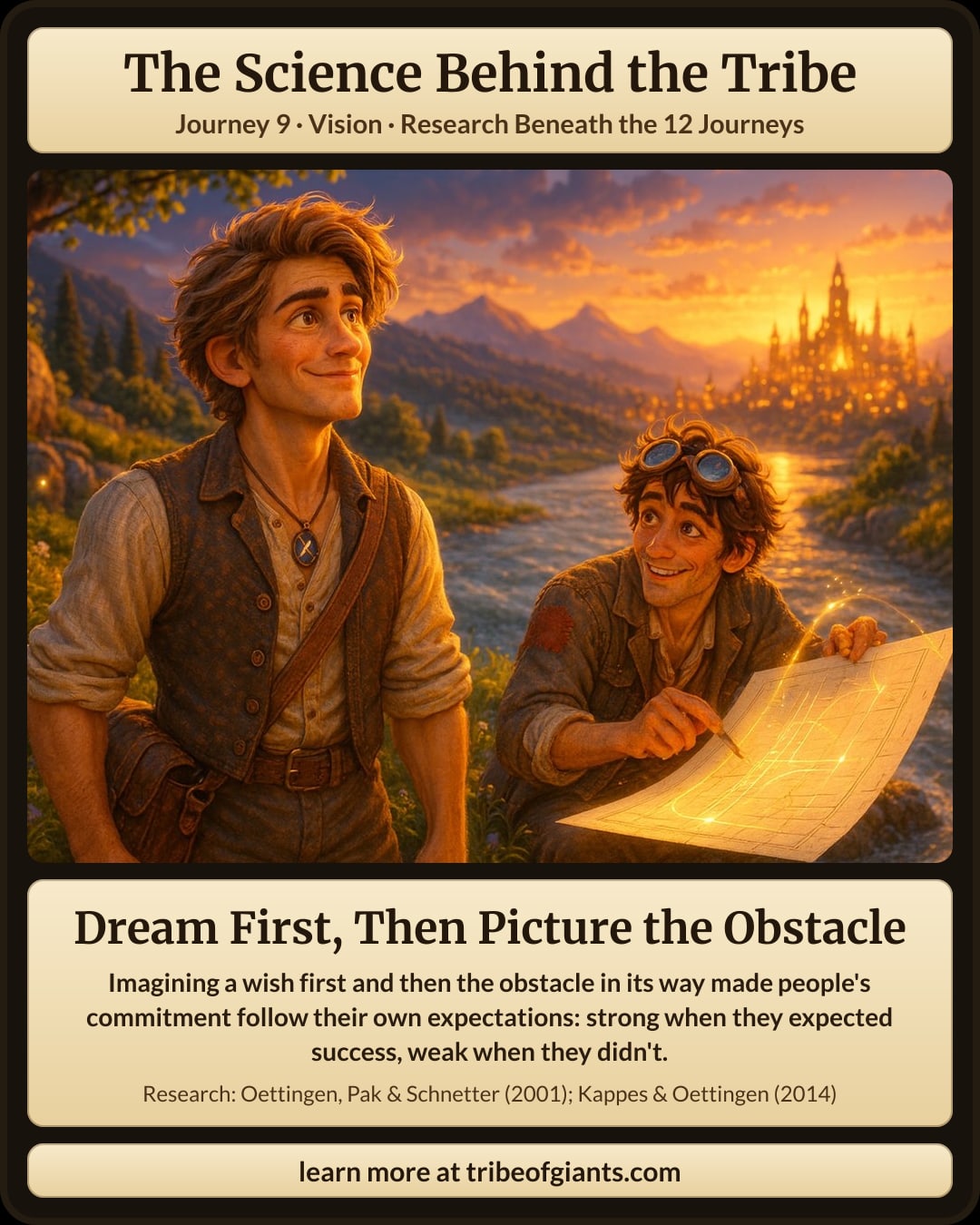
Journey 9 · Vision
Dream First, Then Picture the Obstacle
Imagining a wish first and then the obstacle in its way made people's commitment follow their own expectations: strong when they expected success, weak when they didn't.
In experiments by Gabriele Oettingen and colleagues, people imagined a wished-for future first, then the obstacle in present reality standing in its way. This mental contrasting made their commitment follow their own expectations of success: strong when they expected to succeed, weak when they didn't. People who only dreamed, or only dwelt on obstacles, stayed middling in their commitment whatever they expected.
Order mattered too: picturing the obstacle first and the dream second didn't produce the same effect in these studies. And this isn't a way to make every wish feel within reach. Its job is to sort: firmer commitment to the wishes you expect to reach, a looser hold on the ones you don't.
Journey 9, Vision, guided by Drish, runs it in exactly this order in its sixth session, as WOOP: Wish, Outcome, then Obstacle, then Plan. Which wish of yours has never been set beside the thing in its way?
The research
Strong evidence Replicated findings and meta-analyses.
- Oettingen, G., Pak, H., & Schnetter, K. (2001). Self-regulation of goal setting: Turning free fantasies about the future into binding goals. Journal of Personality and Social Psychology, 80(5), 736–753.
- Kappes, A., & Oettingen, G. (2014). The emergence of goal pursuit: Mental contrasting connects future and reality. Journal of Experimental Social Psychology, 54, 25–39.
A free account for life, with All-Access free for your first 30 days. No card.
Join free