Journey 7 · Uncertainty
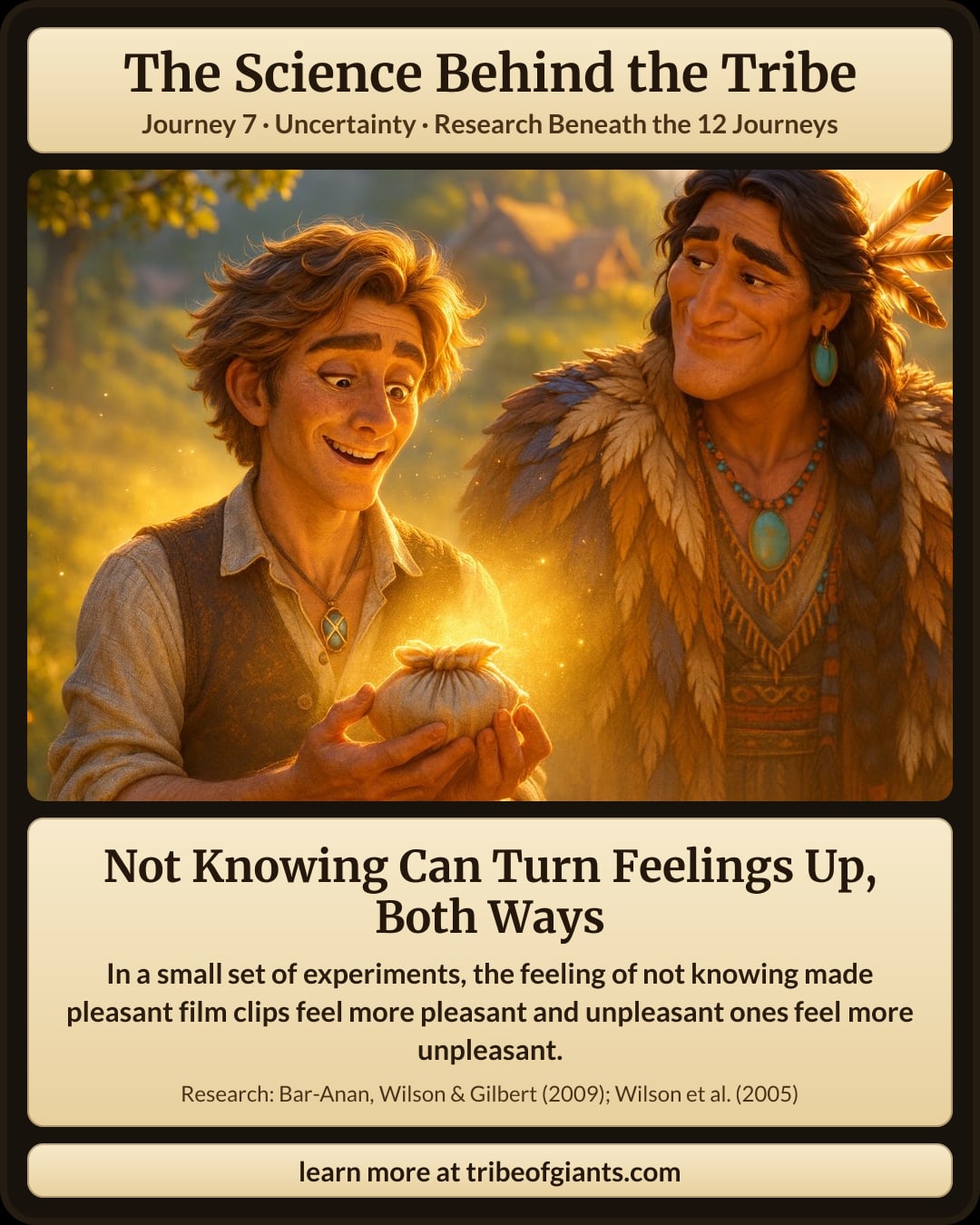
Not Knowing Can Turn Feelings Up, Both Ways
In a small set of experiments, the feeling of not knowing made pleasant film clips feel more pleasant and unpleasant ones feel more unpleasant.
Researchers changed only the feeling of not knowing while people watched film clips. With that feeling present, pleasant clips felt more pleasant and unpleasant ones more unpleasant (Bar-Anan, Wilson & Gilbert, 2009). In earlier experiments, good moods lasted longer when people couldn't easily explain a pleasant surprise, and people asked to predict the result tended to expect the opposite (Wilson et al., 2005).
This is a small body of research: a handful of careful experiments, largely from one research group. And it cuts both ways. Uncertainty doesn't always feel good; in the film studies it intensified unpleasant reactions as well as pleasant ones. Not knowing isn't only a cost, but it isn't only a gift either.
Journey 7, Uncertainty, guided by Tawa, sees the unknown as more than a cost. Alongside settling the body, the journey asks a question of its own: what if this unknown holds a possibility I haven't seen? What unknown in your week could you hold as a question?
The research
Growing evidence Real research that's still building — results are promising and still being tested.
- Bar-Anan, Y., Wilson, T. D., & Gilbert, D. T. (2009). The feeling of uncertainty intensifies affective reactions. Emotion, 9(1), 123–127.
- Wilson, T. D., Centerbar, D. B., Kermer, D. A., & Gilbert, D. T. (2005). The pleasures of uncertainty: Prolonging positive moods in ways people do not anticipate. Journal of Personality and Social Psychology, 88(1), 5–21.
A free account for life, with All-Access free for your first 30 days. No card.
Join free