Journey 7 · Uncertainty
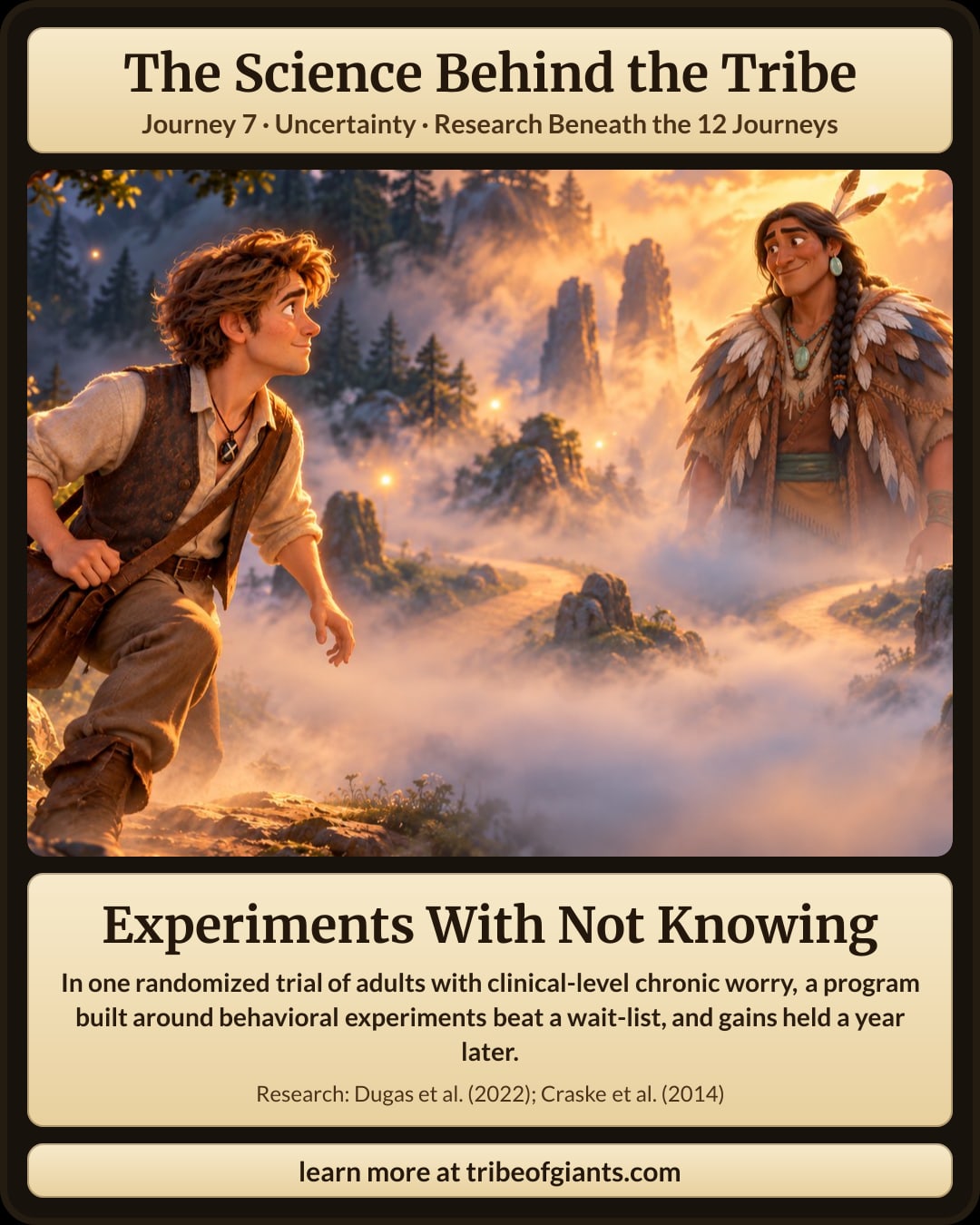
Experiments With Not Knowing
In one randomized trial of adults with clinical-level chronic worry, a program built around behavioral experiments beat a wait-list, and gains held a year later.
Researchers built a program for intolerance of uncertainty, the struggle to bear not knowing, around behavioral experiments: testing worst-case beliefs about not knowing by acting and seeing what happens. In a randomized clinical trial of 60 adults with clinical-level chronic worry, those who did its 12 weekly sessions improved more than a wait-list on every outcome measured, and gains held or grew over twelve months (Dugas et al., 2022).
Why might it work? One idea is borrowed from research on facing fears, where researchers propose that facing them works partly by violating expectations: what actually happens differs from what you predicted (Craske et al., 2014). A plan is still a prediction; a step gives you evidence. The limits: this was one trial, in adults with clinical-level worry, so its results may not apply to everyone, and one experiment isn't enough on its own.
Journey 7, Uncertainty, guided by Tawa, ends with the plank: one small step taken without the whole map, a behavioral experiment of your own. What is one small step you could take this week, just to see what happens?
The research
Growing evidence Real research that's still building — results are promising and still being tested.
- Dugas, M. J., Sexton, K. A., Hebert, E. A., Bouchard, S., Gouin, J.-P., & Shafran, R. (2022). Behavioral experiments for intolerance of uncertainty: A randomized clinical trial for adults with generalized anxiety disorder. Behavior Therapy, 53(6), 1147–1160.
- Craske, M. G., Treanor, M., Conway, C. C., Zbozinek, T., & Vervliet, B. (2014). Maximizing exposure therapy: An inhibitory learning approach. Behaviour Research and Therapy, 58, 10–23.
A free account for life, with All-Access free for your first 30 days. No card.
Join free