Journey 1 · Non-Consciousness
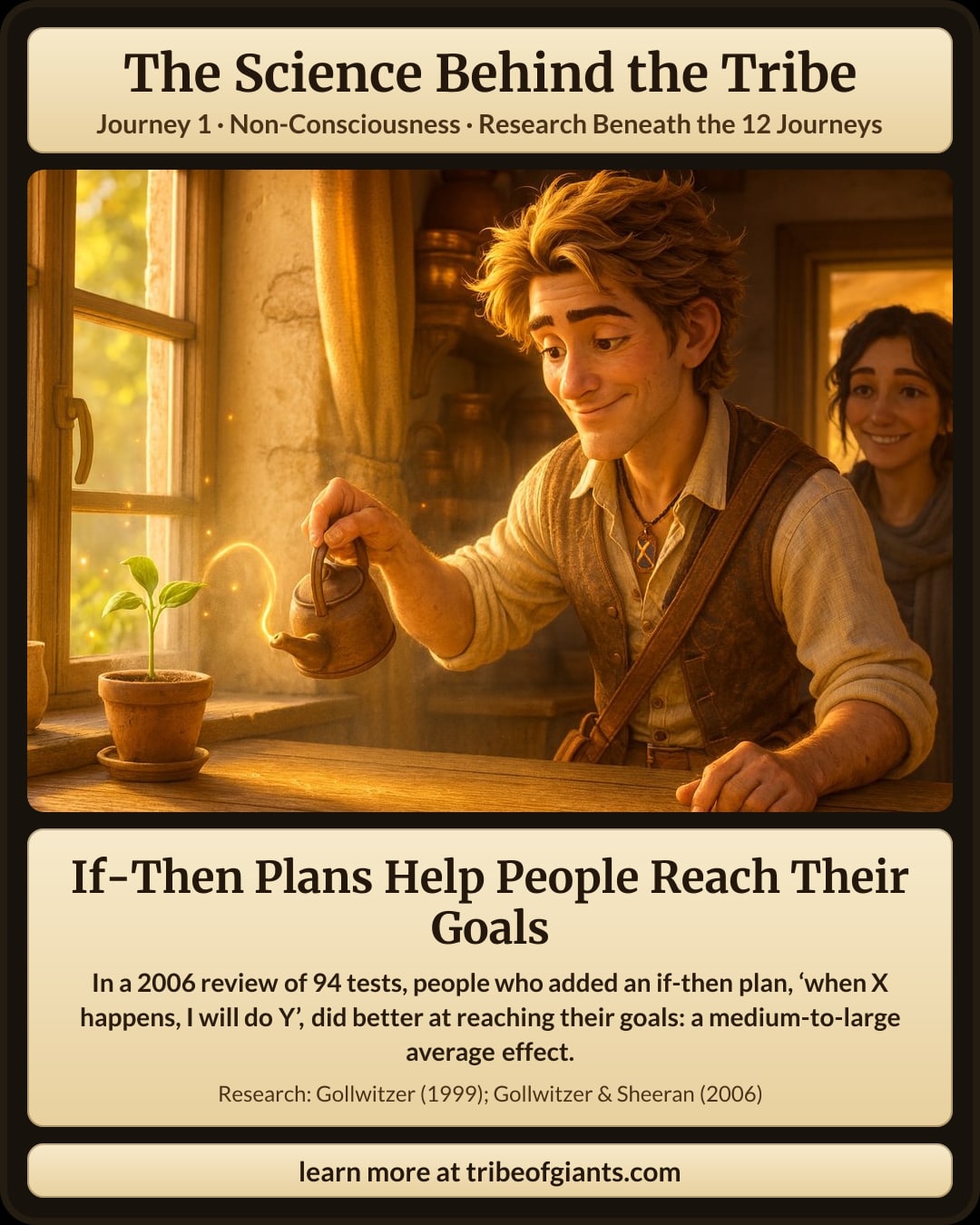
If-Then Plans Help People Reach Their Goals
In a 2006 review of 94 tests, people who added an if-then plan, ‘when X happens, I will do Y’, did better at reaching their goals: a medium-to-large average effect.
Psychologist Peter Gollwitzer calls it an implementation intention: a plan of the form, when situation X arises, I will do Y. In 2006, Gollwitzer and Paschal Sheeran pooled 94 independent tests of these plans. On average, forming one had a medium-to-large positive effect on reaching the goal.
The plans helped people get started, stay on course when distractions or other unwanted influences came up, and let go of approaches that weren’t working. A plan doesn’t replace practice. What it adds is a cue: when the moment arrives, the response is already decided.
In Journey 1, Non-Consciousness, Session 6 asks for exactly this: ‘After I ___, I will ___’, a small, two-minute act hung on something you already do. What daily moment could carry yours?
The research
Strong evidence Replicated findings and meta-analyses.
- Gollwitzer, P. M. (1999). Implementation intentions: Strong effects of simple plans. American Psychologist, 54(7), 493–503.
- Gollwitzer, P. M., & Sheeran, P. (2006). Implementation intentions and goal achievement: A meta-analysis of effects and processes. Advances in Experimental Social Psychology, 38, 69–119.
A free account for life, with All-Access free for your first 30 days. No card.
Join free