Journey 1 · Non-Consciousness
Self-Talk in Your Own Name Can Help Under Social Stress
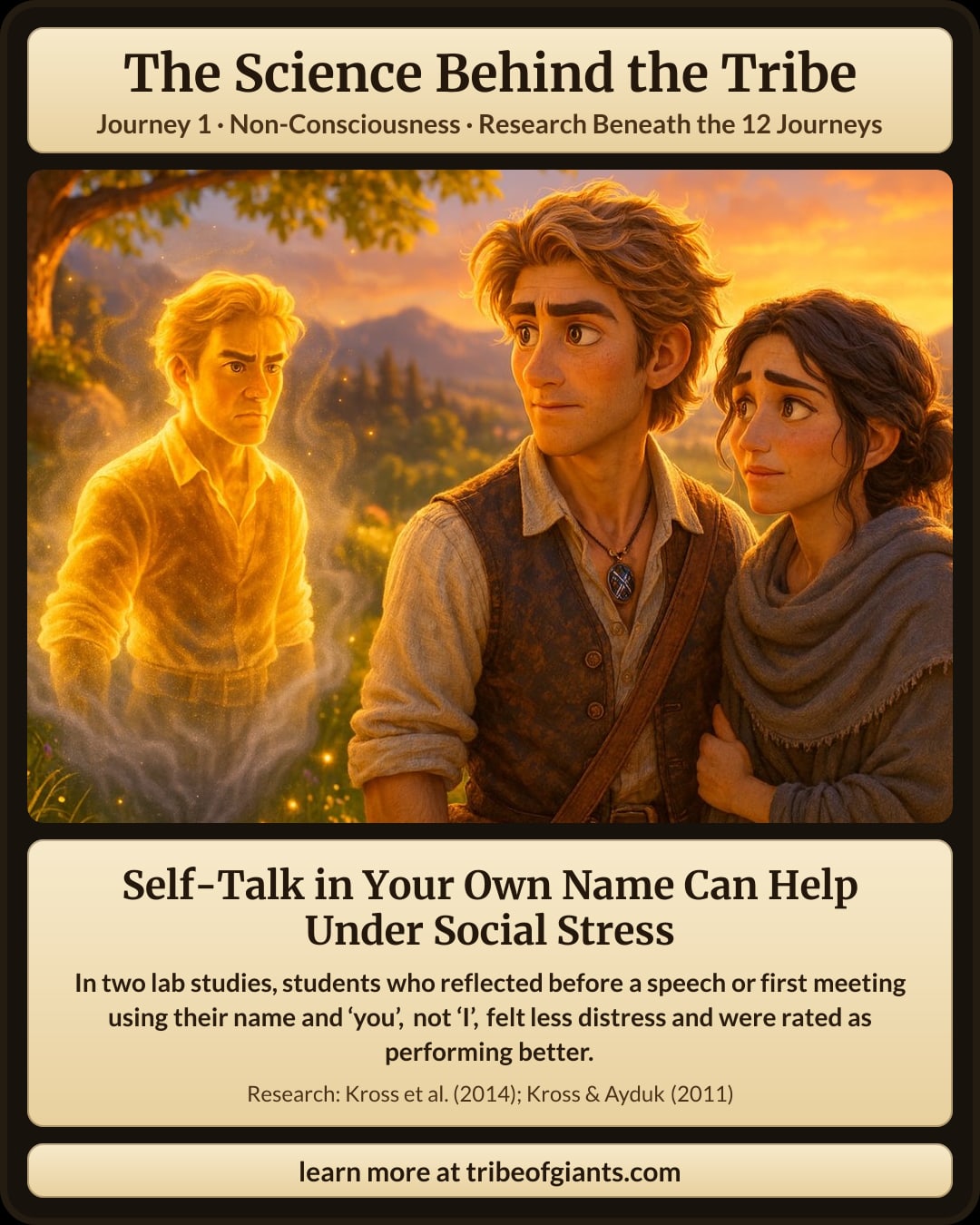
In two lab studies, students who reflected before a speech or first meeting using their name and ‘you’, not ‘I’, felt less distress and were rated as performing better.
Kross and colleagues ran seven studies with 585 people, mostly university students. In two, students facing a first meeting or a speech silently reflected on their feelings beforehand, some using ‘I’, others their own name and ‘you’. The name-and-‘you’ group felt less distress, blind raters judged them as performing better, and in the minutes after the speech they dwelt on it less.
Researchers call this self-distancing: looking at an experience from a step back instead of from inside it. In two other studies in the set, the same self-talk led people to see an upcoming stressor as more of a challenge and less of a threat. These were short lab tasks, and the effects were modest. In lab studies reviewed by Kross and Ayduk, stepping back also helped people reflect on hard experiences with less distress in the moment.
Journey 1, Non-Consciousness, is designed around a related kind of distance. Layla’s story comes before the science, so you meet the pattern in someone else first, and the Awareness step names it as ‘a part of me that…’, something to look at rather than look through. How would today’s hardest moment read in your own name?
The research
Strong evidence Replicated findings and meta-analyses.
- Kross, E., Bruehlman-Senecal, E., Park, J., Burson, A., Dougherty, A., Shablack, H., Bremner, R., Moser, J., & Ayduk, O. (2014). Self-talk as a regulatory mechanism: How you do it matters. Journal of Personality and Social Psychology, 106(2), 304–324.
- Kross, E., & Ayduk, O. (2011). Making meaning out of negative experiences by self-distancing. Current Directions in Psychological Science, 20(3), 187–191.
A free account for life, with All-Access free for your first 30 days. No card.
Join free