Journey 1 · Non-Consciousness
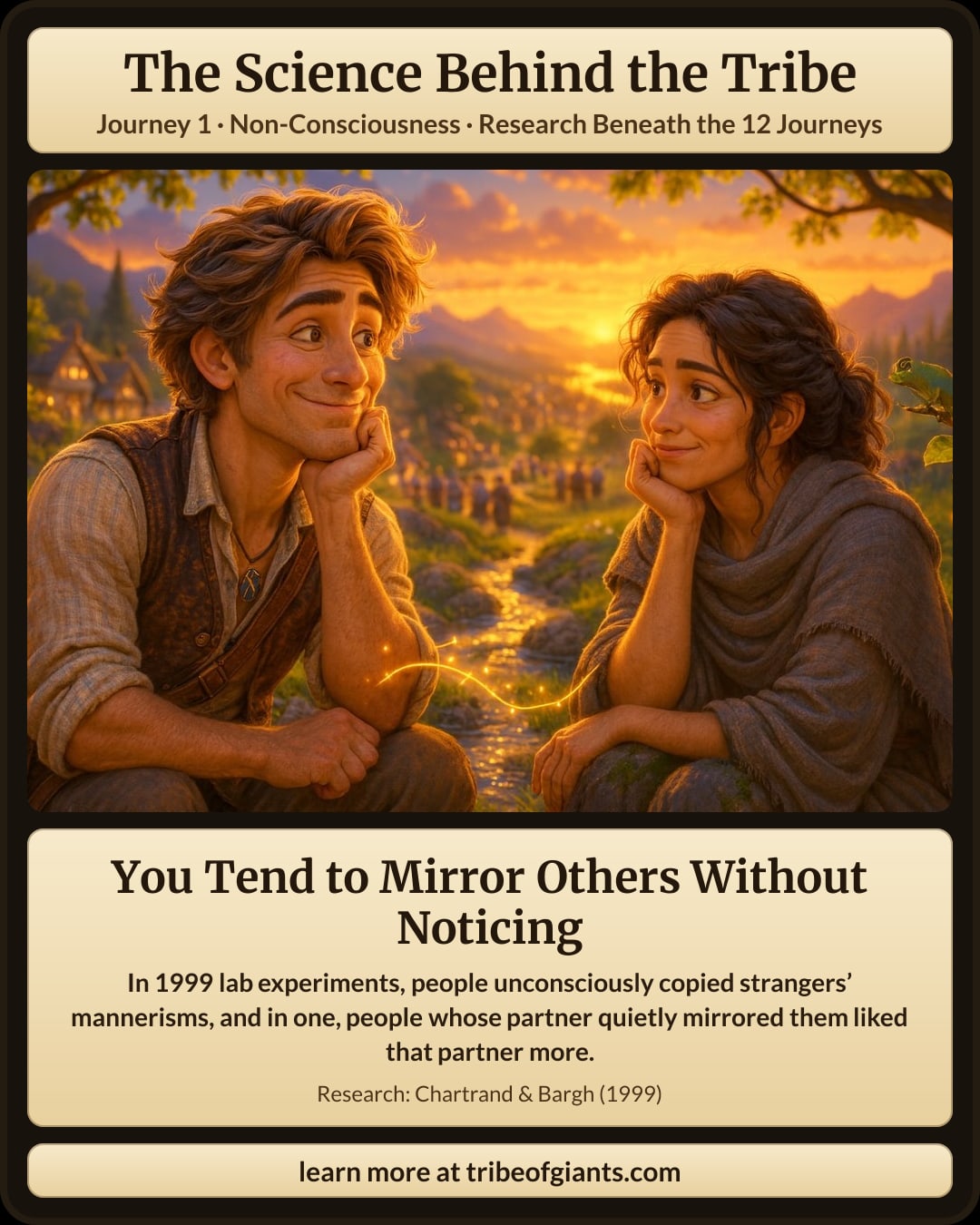
You Tend to Mirror Others Without Noticing
In 1999 lab experiments, people unconsciously copied strangers’ mannerisms, and in one, people whose partner quietly mirrored them liked that partner more.
In a 1999 experiment, Tanya Chartrand and John Bargh had college students describe photos with two strangers, one after the other. When one stranger rubbed their face and the other shook a foot, participants tended to do more of whatever their current partner did. In a second experiment, a partner quietly mirrored participants’ postures and movements, and those participants liked the partner more and found the interaction smoother.
Participants didn’t set out to copy anyone; the matching happened unintentionally, and the researchers called this nonconscious mimicry the chameleon effect. These were small lab experiments, and the liking result came from a single experiment, so take the details as a lead, not a rule. How the brain does this mirroring, including the popular mirror-neuron explanation, is still debated.
In Journey 1, Non-Consciousness, Layla’s echoing is this everyday effect made visible. The studies measured movements, not beliefs; the practice borrows the idea as a question: when did you last take on someone else’s view without ever choosing it?
The research
Growing evidence Real research that's still building — results are promising and still being tested.
- Chartrand, T. L., & Bargh, J. A. (1999). The chameleon effect: The perception–behavior link and social interaction. Journal of Personality and Social Psychology, 76(6), 893–910.
A free account for life, with All-Access free for your first 30 days. No card.
Join free