Journey 4 · Acceptance
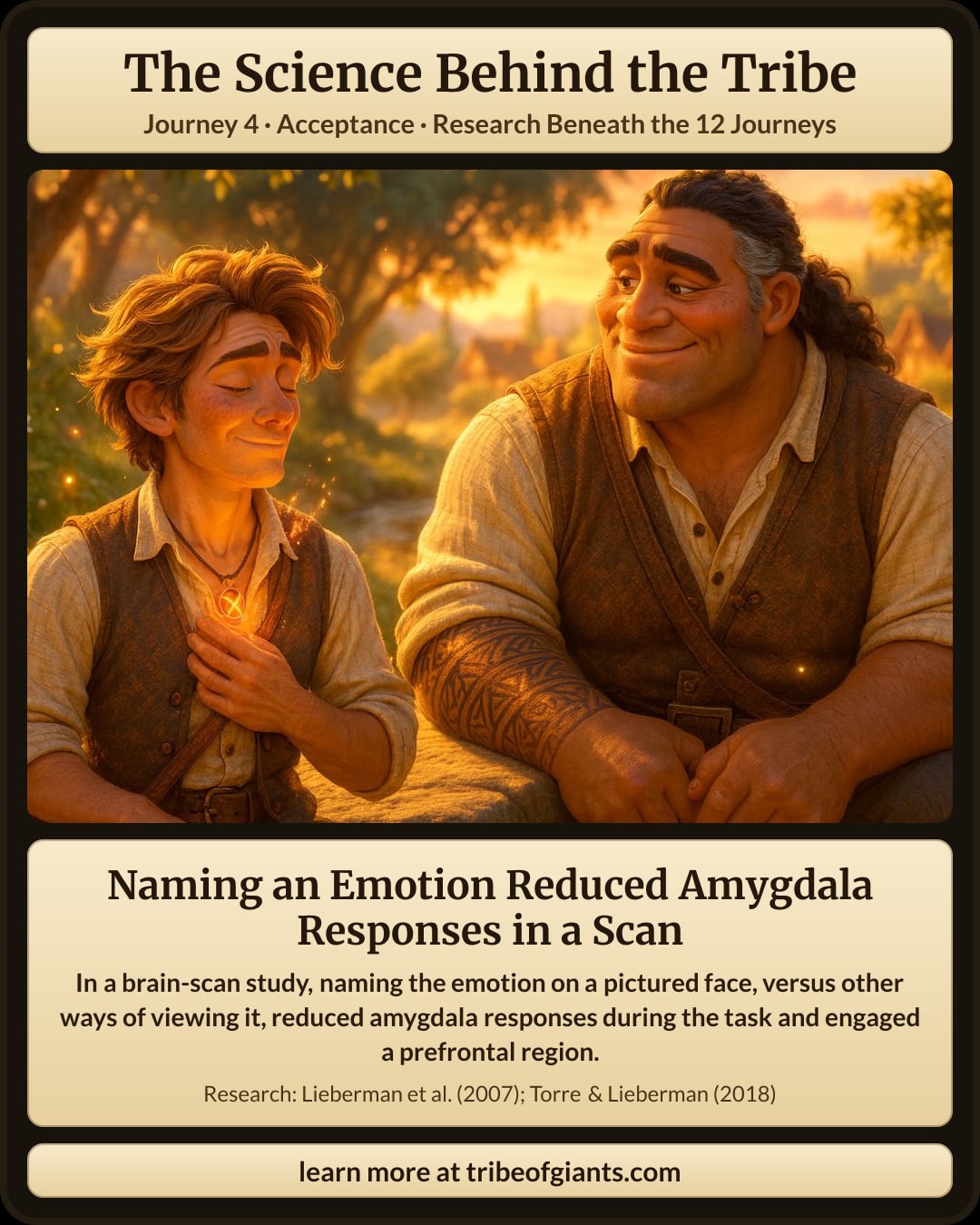
Naming an Emotion Reduced Amygdala Responses in a Scan
In a brain-scan study, naming the emotion on a pictured face, versus other ways of viewing it, reduced amygdala responses during the task and engaged a prefrontal region.
Lieberman and colleagues (2007) scanned people’s brains while they looked at photos of emotional faces. When people chose a word naming the emotion on the face, compared with other ways of responding to the same faces, responses in the amygdala, a region involved in detecting threat, were reduced, and the right ventrolateral prefrontal cortex became more active.
A 2018 review by Torre and Lieberman describes putting feelings into words as a form of implicit emotion regulation, with effects on feeling, physiology and behaviour: regulation that may not feel like regulation while it happens. Keep the scope in mind. The scan measured responses during a lab task, not a lasting change; no one brain region is simply an alarm; and naming a feeling doesn’t make it vanish.
In Journey 4, Acceptance, guided by Noa, this is the research under the Internal Weather Report: you find what you feel and label it, Resistance or Flow. You aren’t trying to change the feeling, only to say what it is. What word fits what you feel right now?
The research
Strong evidence Replicated findings and meta-analyses.
- Lieberman, M. D., Eisenberger, N. I., Crockett, M. J., Tom, S. M., Pfeifer, J. H., & Way, B. M. (2007). Putting feelings into words: Affect labeling disrupts amygdala activity in response to affective stimuli. Psychological Science, 18(5), 421–428.
- Torre, J. B., & Lieberman, M. D. (2018). Putting feelings into words: Affect labeling as implicit emotion regulation. Emotion Review, 10(2), 116–124.
A free account for life, with All-Access free for your first 30 days. No card.
Join free