Journey 4 · Acceptance
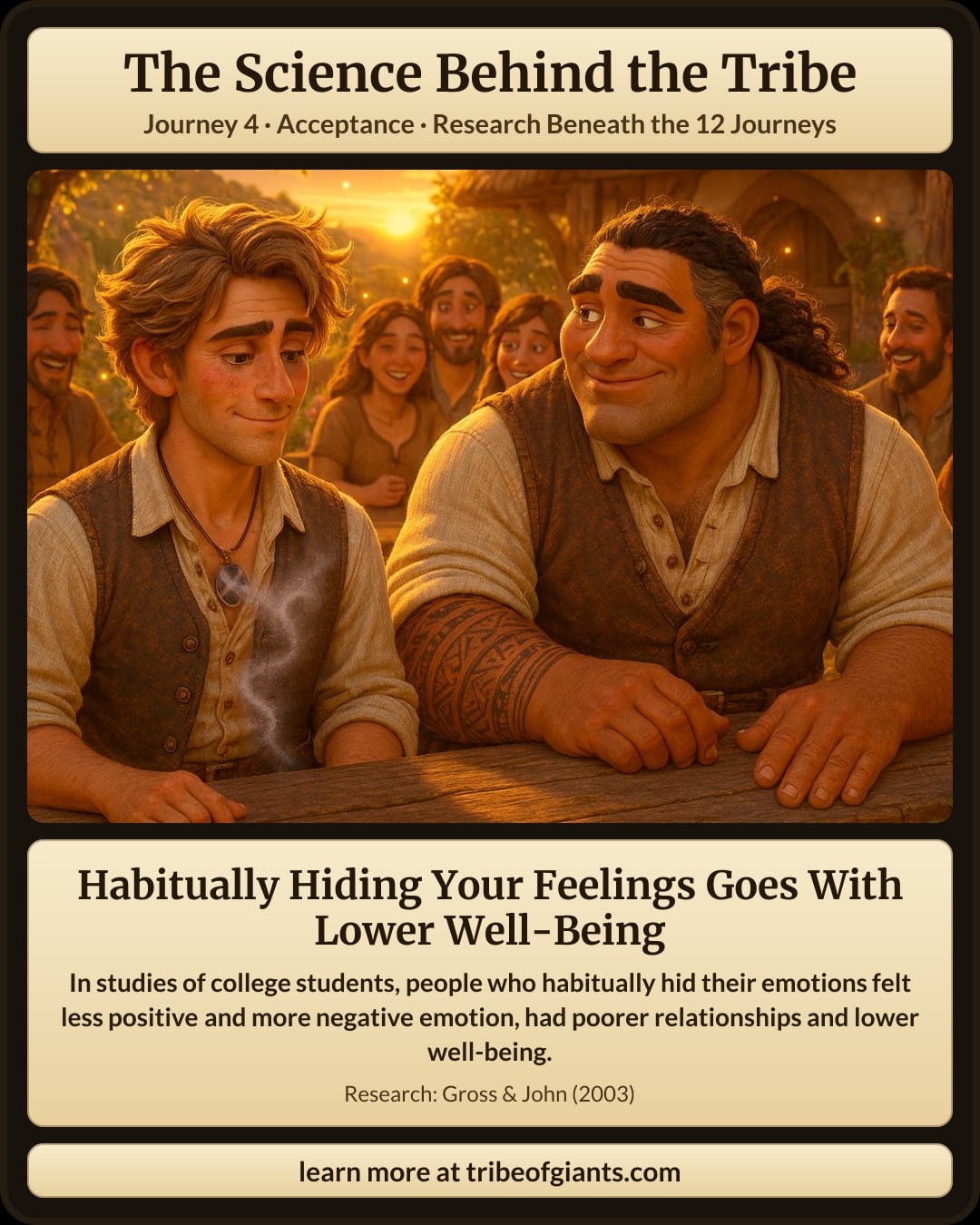
Habitually Hiding Your Feelings Goes With Lower Well-Being
In studies of college students, people who habitually hid their emotions felt less positive and more negative emotion, had poorer relationships and lower well-being.
Gross and John (2003) studied a habit: keeping your feelings from showing, again and again. In a five-study paper with college students, people who habitually suppressed their emotions experienced less positive and more negative emotion, had poorer relationships and reported lower well-being than people who suppressed less.
These are correlations: they show that hiding your feelings and these outcomes tend to go together, not that hiding feelings causes them. The people studied were all college students, a limit the authors name themselves. Within those limits, the more often people kept their feelings from showing, the fewer good feelings and the poorer relationships they tended to have.
Journey 4, Acceptance, guided by Noa, sees a brave face as a cost, not a strength, and this research is part of why. Acceptance here isn’t voicing every feeling everywhere. It’s contact with what you feel: no verdict on it, and no cover over it. Where in your week are you keeping a brave face?
The research
Strong evidence Replicated findings and meta-analyses.
- Gross, J. J., & John, O. P. (2003). Individual differences in two emotion regulation processes: Implications for affect, relationships, and well-being. Journal of Personality and Social Psychology, 85(2), 348–362.
A free account for life, with All-Access free for your first 30 days. No card.
Join free