Journey 8 · Abundance
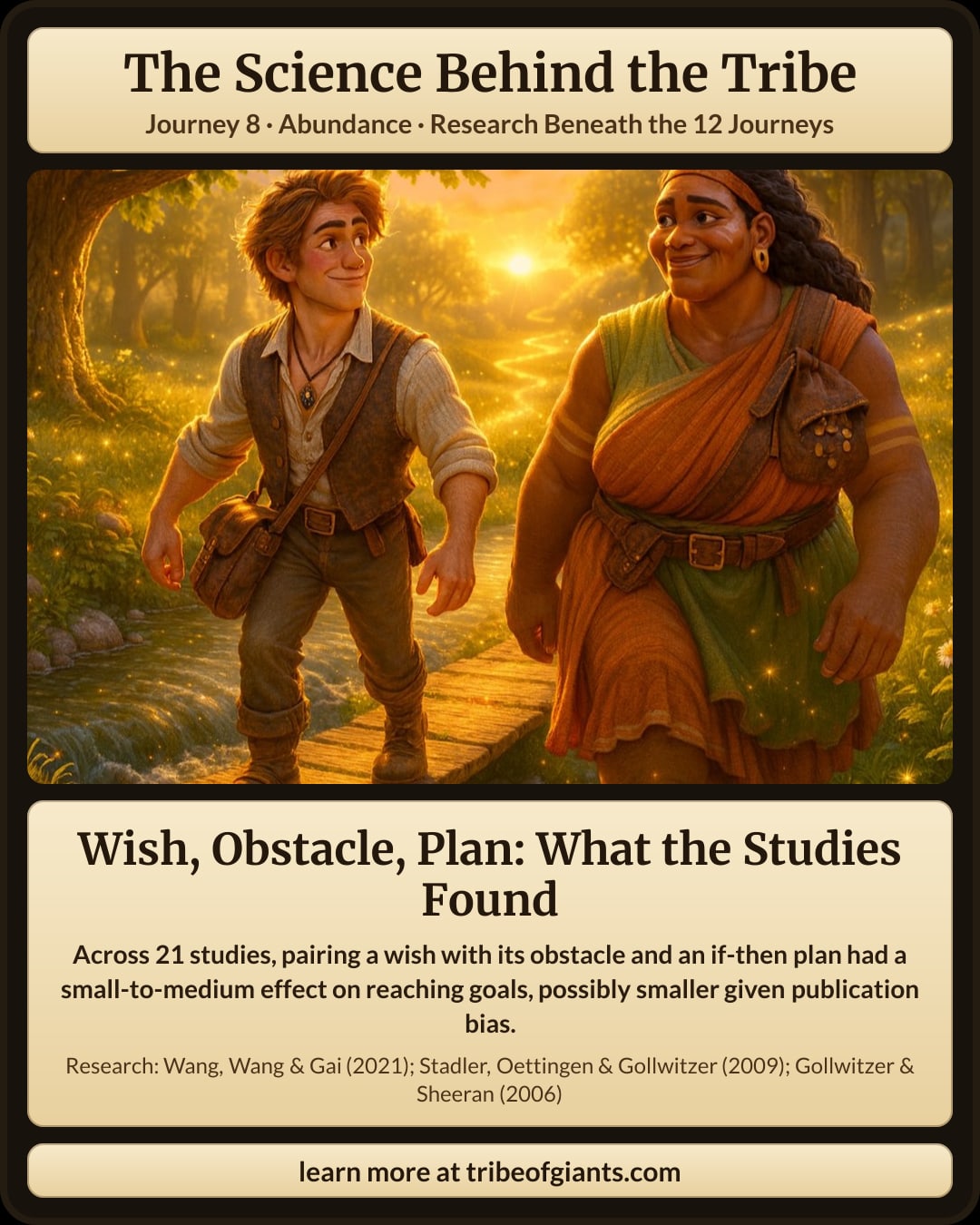
Wish, Obstacle, Plan: What the Studies Found
Across 21 studies, pairing a wish with its obstacle and an if-then plan had a small-to-medium effect on reaching goals, possibly smaller given publication bias.
The method: name a wish, picture its outcome, name the inner obstacle, then make an if-then plan. Across 21 studies it had a small-to-medium effect on goal attainment, possibly smaller given publication bias (Wang, Wang & Gai, 2021). In one trial of 256 women, those who also learned it reported being about twice as active over four months as women given health information alone (Stadler, Oettingen & Gollwitzer, 2009).
In a separate review, if-then plans on their own showed a medium-to-large average effect (Gollwitzer & Sheeran, 2006). The two reviews covered different studies, so the sizes are not a head-to-head comparison. None of this guarantees a goal. It means the plan is built for the real moment, obstacle included, not only the hopeful one.
In its final session, Journey 8, Abundance, uses WOOP: Wish, Outcome, Obstacle, Plan. You build the plan yourself and turn it into a two-minute if-then hung on something you already do. Each repetition is a small, lived proof against ‘there’s not enough.’ What obstacle would you name first?
The research
Strong evidence Replicated findings and meta-analyses.
- Wang, G., Wang, Y., & Gai, X. (2021). A meta-analysis of the effects of mental contrasting with implementation intentions on goal attainment. Frontiers in Psychology, 12, 565202.
- Stadler, G., Oettingen, G., & Gollwitzer, P. M. (2009). Physical activity in women: Effects of a self-regulation intervention. American Journal of Preventive Medicine, 36(1), 29–34.
- Gollwitzer, P. M., & Sheeran, P. (2006). Implementation intentions and goal achievement: A meta-analysis of effects and processes. Advances in Experimental Social Psychology, 38, 69–119.
A free account for life, with All-Access free for your first 30 days. No card.
Join free