Journey 8 · Abundance
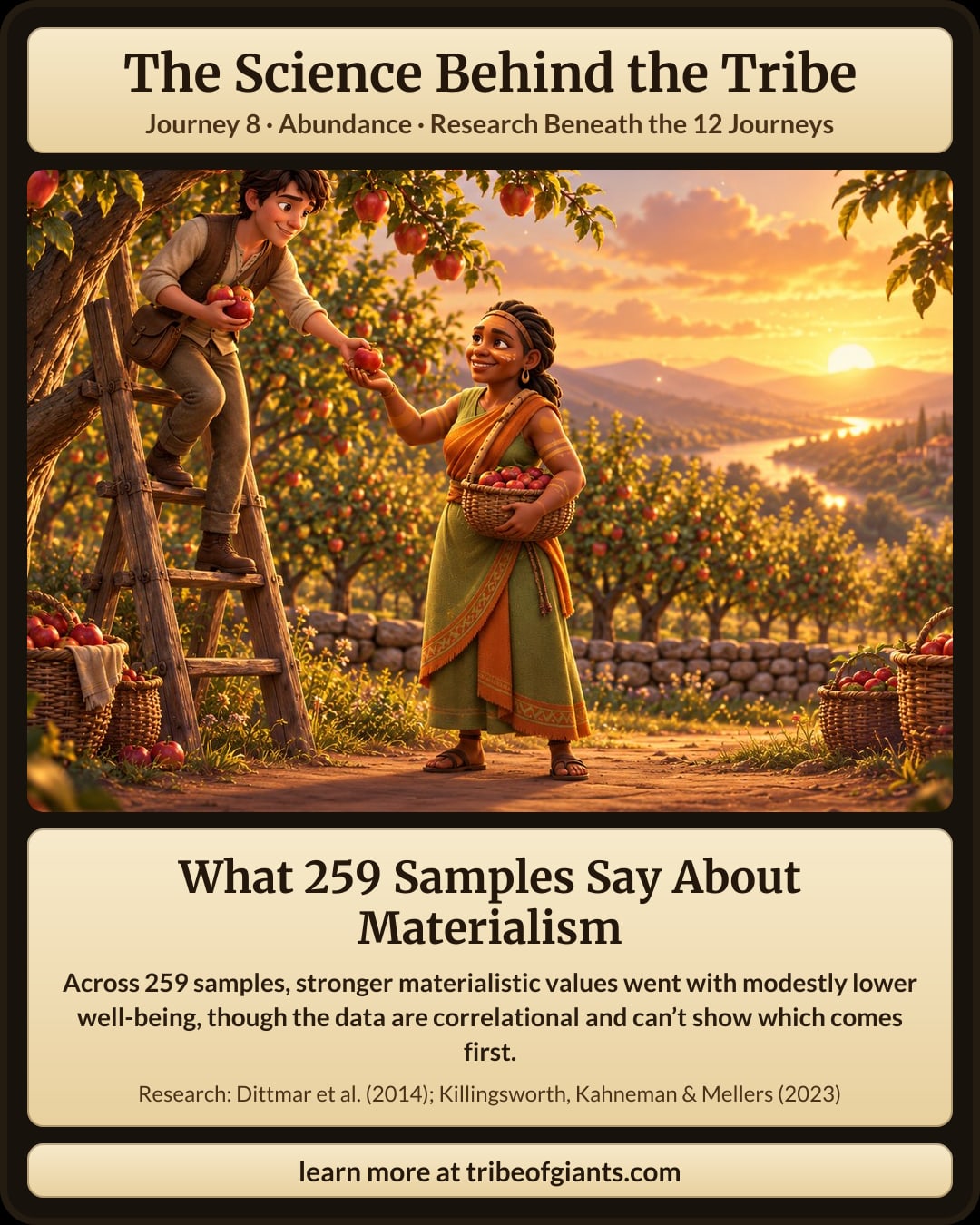
What 259 Samples Say About Materialism
Across 259 samples, stronger materialistic values went with modestly lower well-being, though the data are correlational and can’t show which comes first.
A 2014 meta-analysis pooled 259 samples on materialism: making money and possessions the centre of life. Across them, stronger materialistic values went with modestly lower well-being (Dittmar et al., 2014). The data are correlational, so they can’t show which comes first.
This is not a case against money. In a study of 33,391 employed US adults, built to settle a disagreement between two of its authors, happiness kept rising with income for most; only among the least happy did it level off (Killingsworth, Kahneman & Mellers, 2023). These are snapshot comparisons too, not proof that money causes happiness. What goes with lower well-being is making money and possessions the centre of life.
Journey 8, Abundance, pictures this as the Beast and the Human: the craving self, and the self that knows what is needed is already here. With Abri, you practise noticing when the pull for more fires, naming it without shame, and asking what is already enough to begin. What is enough to begin with today?
The research
Strong evidence Replicated findings and meta-analyses.
- Dittmar, H., Bond, R., Hurst, M., & Kasser, T. (2014). The relationship between materialism and personal well-being: A meta-analysis. Journal of Personality and Social Psychology, 107(5), 879–924.
- Killingsworth, M. A., Kahneman, D., & Mellers, B. (2023). Income and emotional well-being: A conflict resolved. Proceedings of the National Academy of Sciences, 120(10), e2208661120.
A free account for life, with All-Access free for your first 30 days. No card.
Join free