Journey 8 · Abundance
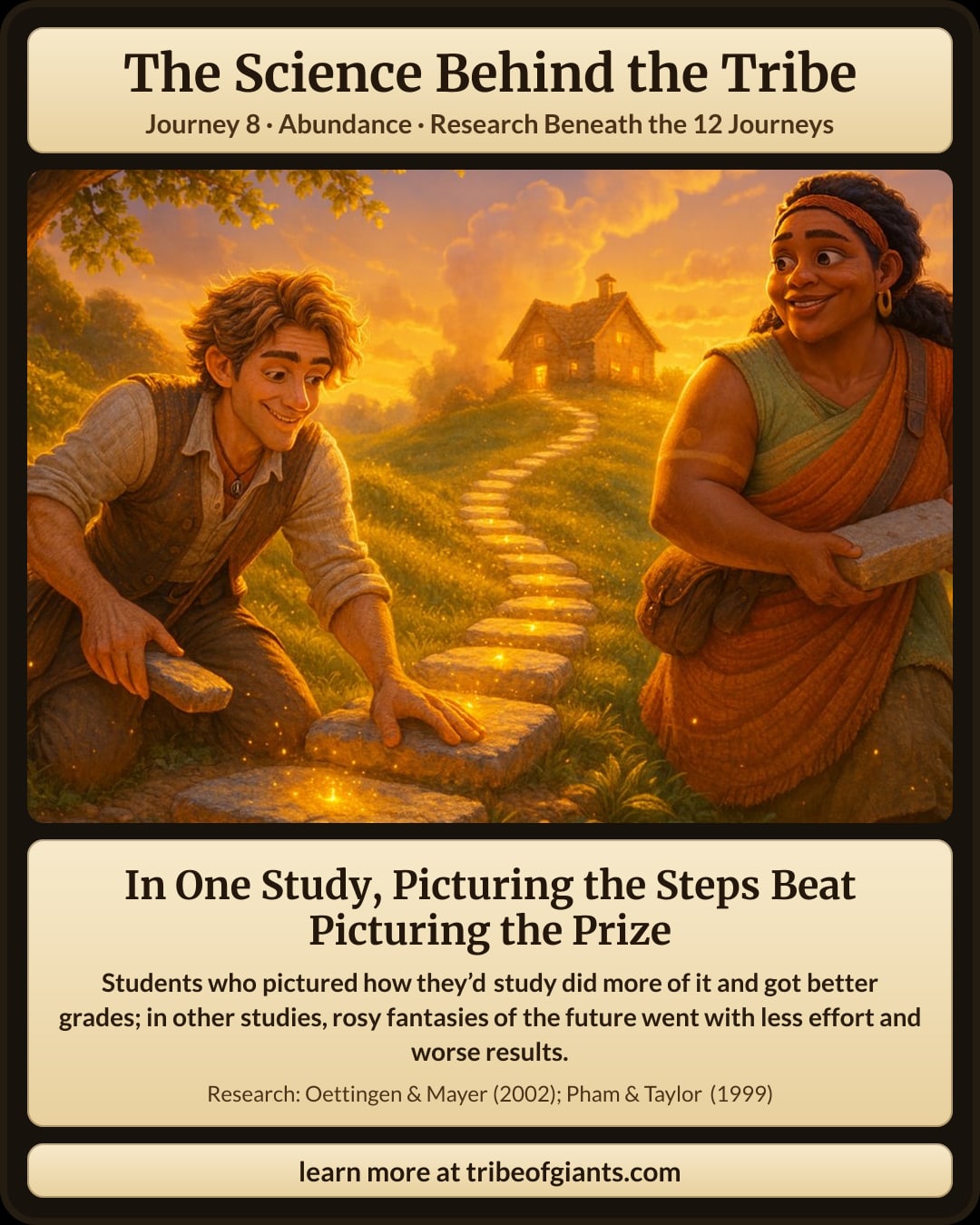
In One Study, Picturing the Steps Beat Picturing the Prize
Students who pictured how they’d study did more of it and got better grades; in other studies, rosy fantasies of the future went with less effort and worse results.
Researcher Gabriele Oettingen and a colleague followed people looking for jobs and students facing exams. Those whose fantasies about the future were most positive went on to make less effort and do worse; those who judged a good outcome likely did better (Oettingen & Mayer, 2002). Separately, college students who pictured how they would study for a midterm, not the high grade, studied more and got better grades (Pham & Taylor, 1999).
These are a handful of studies with particular groups, so read them as early evidence rather than settled. They point one way, though: picturing a wished-for outcome doesn’t bring it to you, and in the study that compared the two, rehearsing the steps is what helped.
That is why Journey 8, Abundance, ties the wish to work. Its I AM statement is written as becoming and tied to a proof you’ll give this week, and its WOOP practice names the obstacle and ends in an if-then plan. What is one step you could picture, then take, this week?
The research
Growing evidence Real research that's still building — results are promising and still being tested.
- Oettingen, G., & Mayer, D. (2002). The motivating function of thinking about the future: Expectations versus fantasies. Journal of Personality and Social Psychology, 83(5), 1198–1212.
- Pham, L. B., & Taylor, S. E. (1999). From thought to action: Effects of process- versus outcome-based mental simulations on performance. Personality and Social Psychology Bulletin, 25(2), 250–260.
A free account for life, with All-Access free for your first 30 days. No card.
Join free