
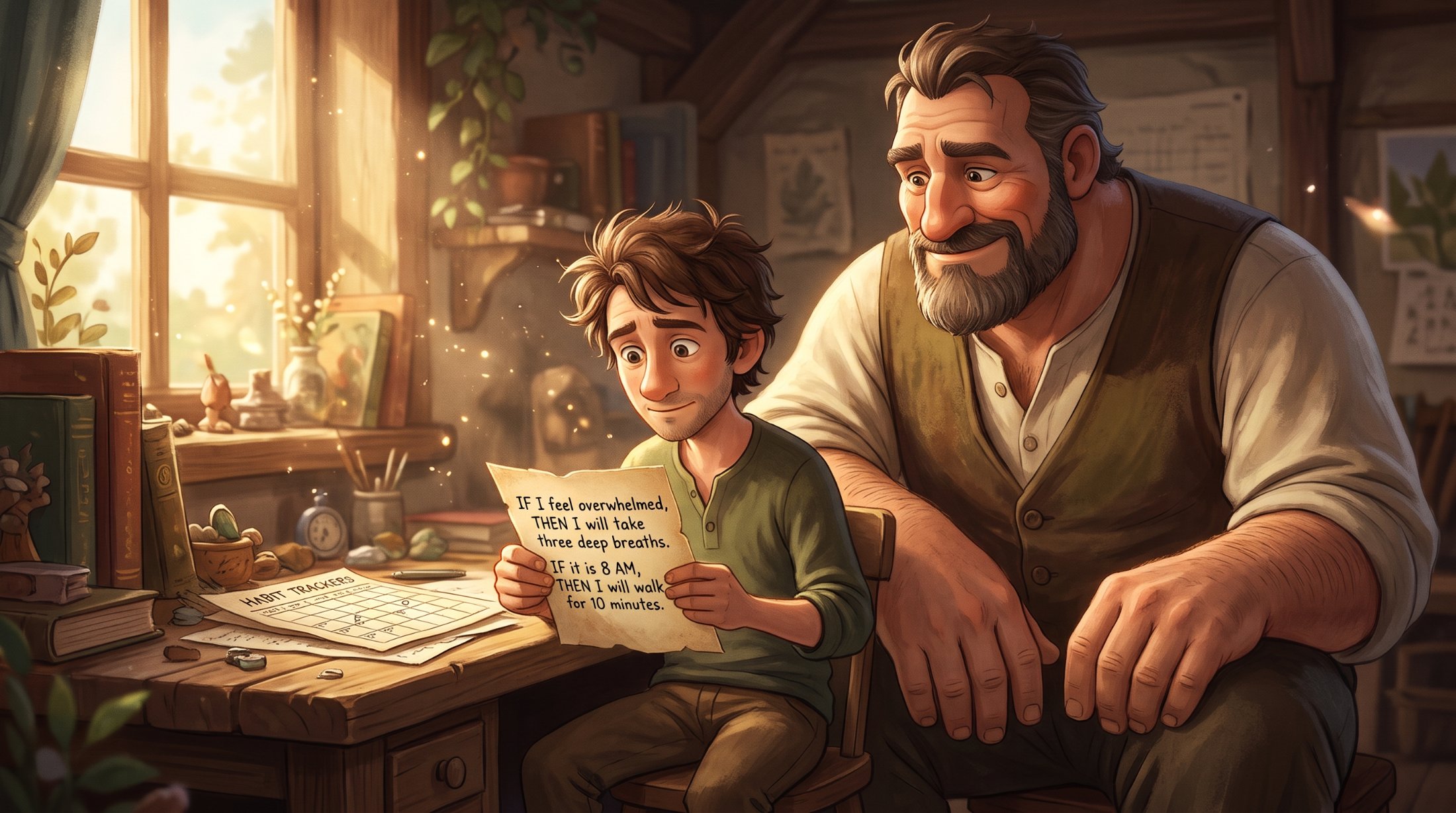
Why If-Then Plans Work (Even If You Hate Routines)
Why if-then plans work even if you hate routines: it's one sentence, not a system — the cue, the move, and why it sometimes needs the Acceptance journey.
The Tribe of Giants · November 17, 2026

You can grieve a parent you were estranged from, and the grief will not look like the kind people expect. There may be no flood of sorrow — instead relief, anger, guilt, and loss arriving in the same hour, sometimes the same breath. Naming all of it, without picking the "correct" feeling, is the starting point.
TL;DR: Estrangement grief is real grief, but it carries extra weight most people never have to carry: relief that can feel like betrayal, anger with nowhere left to send it, and a story that never got its ending. The Grief journey inside My 12 Journeys — guided by the character Soraya — gives you a place to feel all of it honestly, one day at a time, instead of alone and in silence.
When you lose a parent you were close to, the grief is mostly about absence — the empty chair, the missed calls. When you lose a parent you were estranged from, the grief is about an ending that was already unfinished. You're not just mourning the person who died. You're mourning the conversation you never had, the apology that never came, the version of the relationship you quietly hoped might still happen someday. That hope dies too, and almost nobody acknowledges that second loss out loud.
This is why generic grief advice falls flat here. It assumes a relationship you were actively losing, not one you'd already had to protect yourself from. If you felt a flash of relief when the call came, that doesn't mean you didn't love them, and it doesn't mean you're cold. It means the ending arrived in a form your nervous system had been bracing for, for years.
In the 12 Journeys framework, grief itself confronts the heaviest emotions a person carries — sadness, anger, frustration, guilt — and the word "grief" comes from the Latin gravare, meaning "to make heavy." The journey doesn't ask you to resolve the relationship after the fact. It asks you to feel the actual weight of it, including the parts that don't fit a sympathy card: the relief, the unfinished anger, the guilt about the relief.
The character who guides this journey is Soraya, and her role is to hold the emotional weight of grief with you rather than rush you past it. Her line to Ritt captures the whole approach: "Don't rush this pain. It's remaking you." Nothing about estrangement grief is quick, and nothing in this journey pretends it should be.
Here is what moving through this specific grief can look like, day by day, rather than all at once.
Say it plainly: relief after an estranged parent's death does not make you a bad son or daughter. It usually means the relationship cost you something — your peace, your sense of safety, your energy — for a long time, and that cost just ended. Guilt tends to show up right behind the relief, uninvited. Both are allowed to be in the room. The Grief journey is built to hold contradiction like this instead of asking you to flatten it into one clean emotion for other people's comfort.
If the grief tips into a darker place — if you find yourself wondering what the point of any of it is — that's worth saying out loud to someone now, not sitting with alone. In the US, you can call or text 988, any hour. My 12 Journeys is a growth program, not crisis care, and Rimi is not a substitute for that kind of help when you need it.
Estrangement rarely grieves cleanly on its own. It tends to sit right next to how to accept what you can't change — the fact that the relationship ended the way it did, not the way you wanted. It can also surface questions about how to leave a legacy of your own, especially if the thing you're grieving is also a pattern you don't want to repeat. If the loss landed in your 40s or 50s and reopened bigger questions about what's next, feeling lost at 50 walks through that territory directly. The Grief journey itself — how to process grief — is where all of this work actually happens, day by day, with Soraya and Rimi alongside you.
Every account inside My 12 Journeys — the Tribe of Giants' home for this framework — is free for life: the community, the first journey, and your first Giant Crossing, no card required. Every new account also gets thirty days of full All-Access on top, which includes Journey 3 — Grief, Rimi's daily check-ins, and the measurement that shows you the work is actually landing. After thirty days, keep All-Access for $19 a month or $149 a year only if you want to — cancel any time.
Join free and start the Grief journey tonight. You don't need to have the relationship figured out. You just need to say the true thing to someone, starting today.
Yes. Relief is a common response when a relationship has been painful or unsafe for a long time, and it can sit right alongside real sorrow. Feeling it does not mean the loss wasn't real, and it does not make you a bad child.
Normal grief usually mourns an active, ongoing relationship. Estrangement grief mourns an ending that was already unresolved — the apology, the repair, or the version of the relationship you were still quietly hoping for. You're grieving two things at once: the person, and the ending you didn't get to choose.
No. Forgiveness is not a requirement for grief to move forward, and nothing in the Grief journey asks you to force it on a timeline. The work is feeling the weight of what actually happened, not performing closure you don't feel yet.
Soraya is the character guide who walks alongside this journey, holding the weight of grief with you rather than rushing you past it. Her role is captured in her own words: "Don't rush this pain. It's remaking you."
You can start wherever the pain actually is. The Grief journey is one of twelve inside the 12 Journeys, and while many people move through them in order, this one is built to meet you the moment you need it.
👉 Join free — a free account for life, with All-Access free for your first 30 days
Free, by email
Where this path starts, what changes along it, and one thing you can do today. Then four short letters over two weeks.
Why if-then plans work even if you hate routines: it's one sentence, not a system — the cue, the move, and why it sometimes needs the Acceptance journey.

At 40, a job loss is identity loss, not just career setback. Learn why grieving matters and how small acts rebuild the self after midlife layoff.
You repeat mistakes because an old pattern decides before you do. See how Non-Consciousness, the first 12 Journeys step, helps you catch it earlier.

Never had career direction, not reinventing one? Here's a repeatable process to figure out what to do next in your career — plus where the Vision journey.

Life didn't turn out as planned? Learn why fighting that reality costs more than the loss itself, and the small first step the 12 Journeys' Acceptance.