Journey 3 · Grief
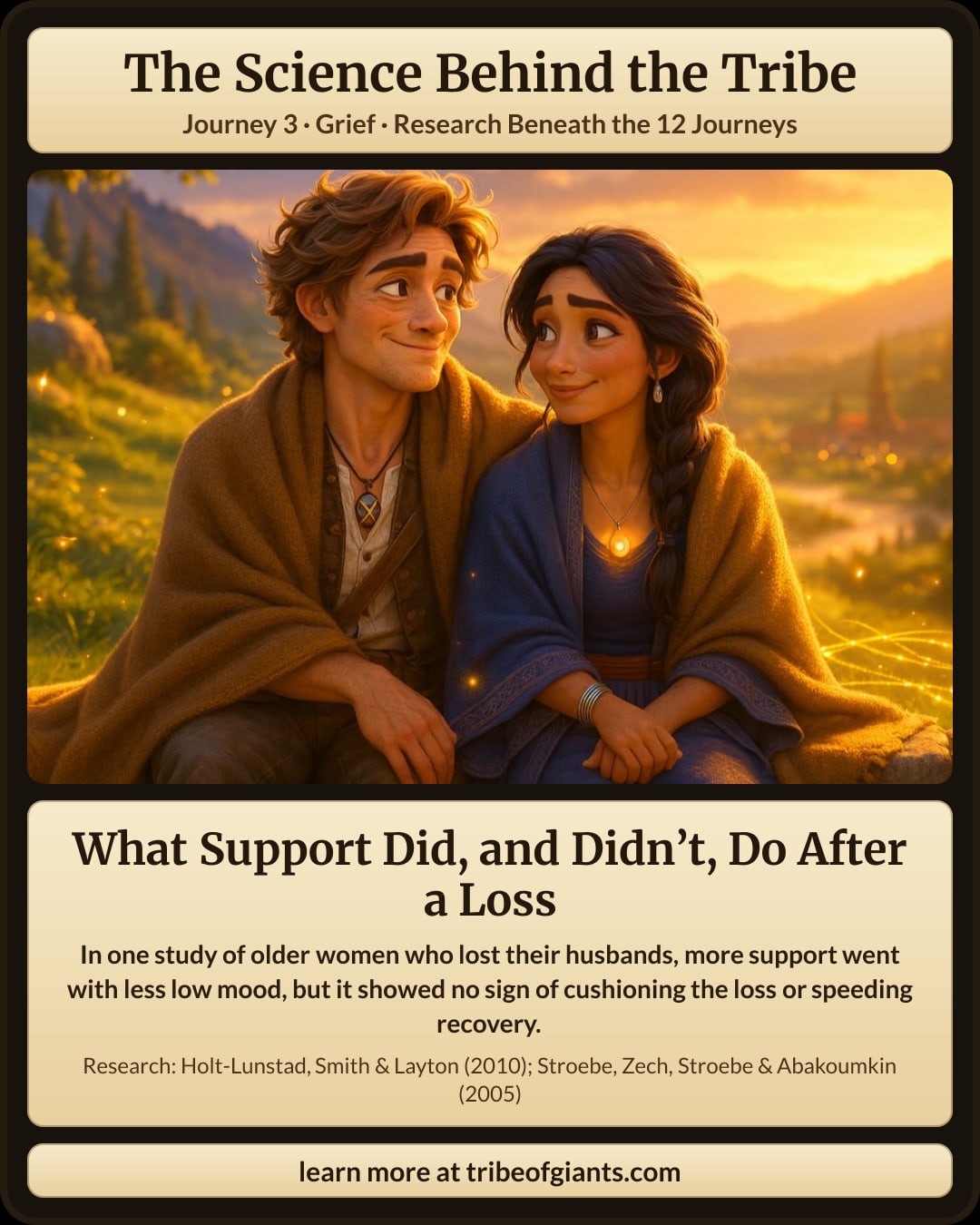
What Support Did, and Didn’t, Do After a Loss
In one study of older women who lost their husbands, more support went with less low mood, but it showed no sign of cushioning the loss or speeding recovery.
A review pooling 148 studies of people in general, not grieving people specifically, found that stronger social relationships went with about a 50% greater likelihood of survival. Another study followed older women from before their husbands died through the years after. Those with more support had less low mood, but support showed no sign of cushioning the loss or speeding recovery.
These are links, not proof of cause. And there’s a limit: support hasn’t been shown to make grief shorter. What it goes with is how you’re doing while you grieve.
That’s why Journey 3, Grief, with Soraya, ends with a plan you can share and a Tribe, not a solitary vow. Who is one person you could tell about your plan?
The research
Strong evidence Replicated findings and meta-analyses.
- Holt-Lunstad, J., Smith, T. B., & Layton, J. B. (2010). Social relationships and mortality risk: A meta-analytic review. PLoS Medicine, 7(7), e1000316.
- Stroebe, W., Zech, E., Stroebe, M. S., & Abakoumkin, G. (2005). Does social support help in bereavement? Journal of Social and Clinical Psychology, 24(7), 1030–1050.
A free account for life, with All-Access free for your first 30 days. No card.
Join free