Journey 6 · Empowerment
Approach, Not Avoidance: The Research on Facing Fear
Staying with a fear long enough to learn is central to psychology’s best-supported methods for strong fears; current models say new learning competes with the old fear.
Researchers call the opposite move exposure: approaching a feared situation and staying long enough to learn something new. In studies of people whose fears got in the way of daily life, it sits at the heart of psychology’s best-supported approaches. In a 2014 review, Craske and colleagues describe the current model, inhibitory learning: the old fear memory isn’t erased. A newer, safer memory is learned that competes with it.
In plain terms, the fear doesn’t have to leave before you begin. In this model, each time you approach and stay, you give your brain new learning to set against the old alarm, which is why the researchers recommend repeated, varied practice. One caution: approaching doesn’t mean throwing yourself into overwhelming situations. The point is a step you can stay with long enough to learn from.
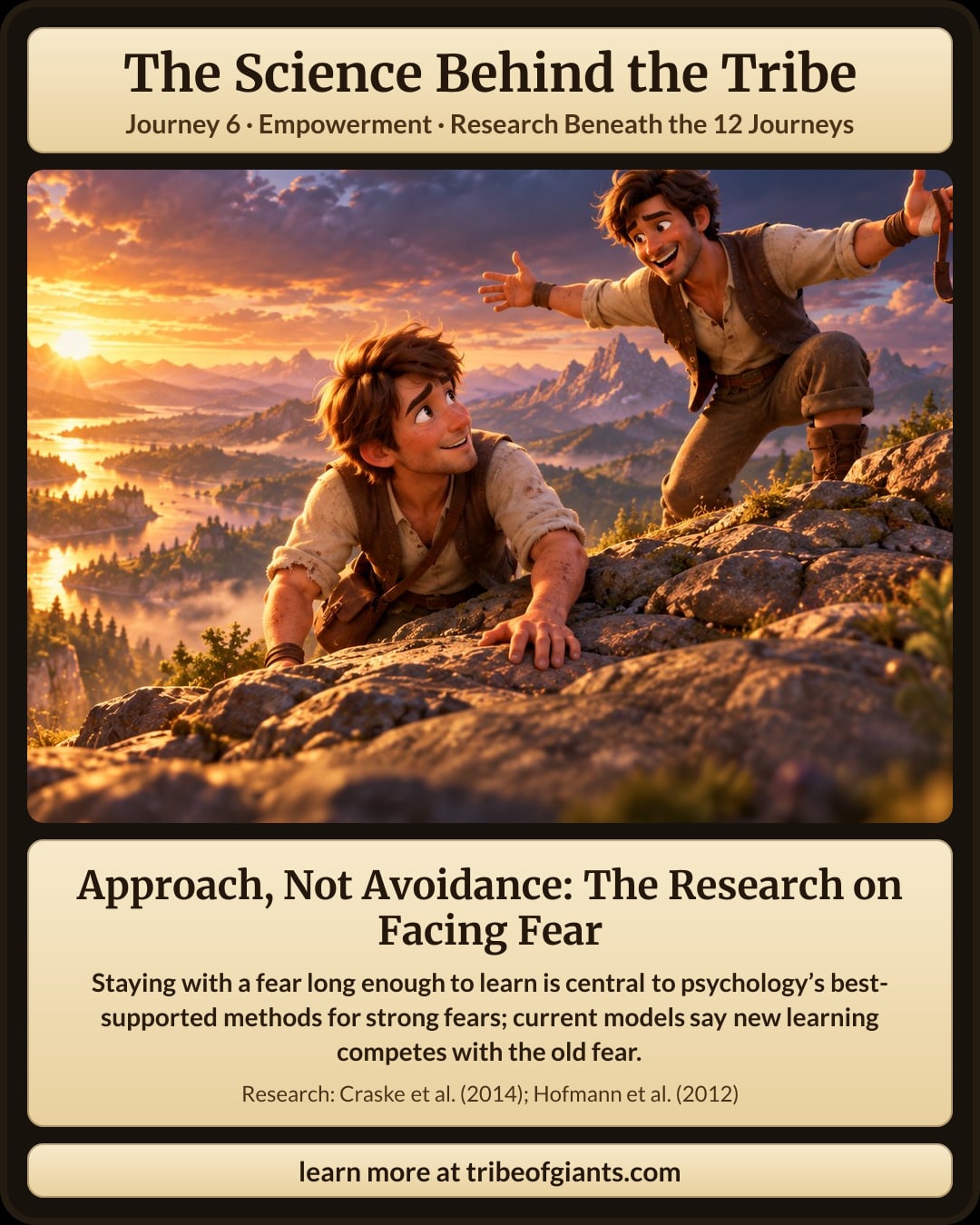
Journey 6, Empowerment, guided by Rayo, puts this to work: it sends you toward the climb in small steps instead of waiting for the fear to fade. What is one small step toward something you have been waiting to feel ready for?
The research
Strong evidence Replicated findings and meta-analyses.
- Craske, M. G., Treanor, M., Conway, C. C., Zbozinek, T., & Vervliet, B. (2014). Maximizing exposure therapy: An inhibitory learning approach. Behaviour Research and Therapy, 58, 10–23.
- Hofmann, S. G., Asnaani, A., Vonk, I. J. J., Sawyer, A. T., & Fang, A. (2012). The efficacy of cognitive behavioral therapy: A review of meta-analyses. Cognitive Therapy and Research, 36(5), 427–440.
A free account for life, with All-Access free for your first 30 days. No card.
Join free