Journey 10 · Surrender
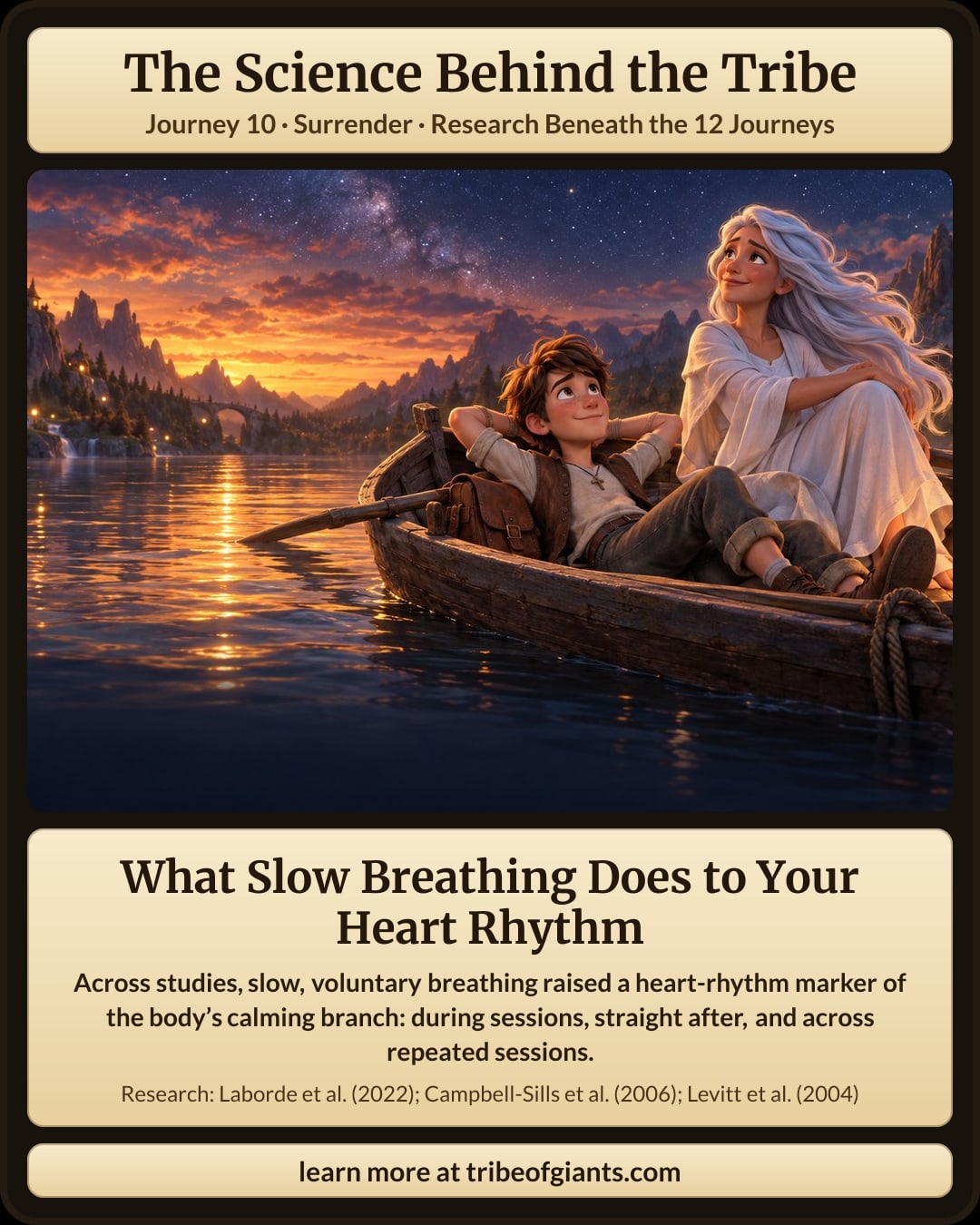
What Slow Breathing Does to Your Heart Rhythm
Across studies, slow, voluntary breathing raised a heart-rhythm marker of the body’s calming branch: during sessions, straight after, and across repeated sessions.
Laborde and colleagues pooled studies of voluntary slow breathing in a meta-analysis. Vagally mediated heart-rate variability, a marker of the parasympathetic nervous system acting on the heart, rose during slow-breathing sessions, straight afterwards, and after programs of several sessions. The parasympathetic branch is the one that slows the heart and supports rest and repair.
What it does not show: that simply deciding to let go switches the body into calm. When researchers compared accepting a feeling with suppressing it, body effects were mixed across two single-session lab studies: heart rate fell in one, and no physiological differences appeared in the other. Of the two, slow breathing is the more reliable lever.
That is why Journey 10, Surrender, pairs its 10% release with a slow breath: you loosen your grip on one thing by 10%, a dose small enough to take on a hard day, as you breathe out slowly. The studies tested sessions of slow breathing, not a single breath, so let that one breath lead into a few more. Where in your day could a few slow breaths fit?
The research
Growing evidence Real research that's still building — results are promising and still being tested.
- Laborde, S., Allen, M. S., Borges, U., Dosseville, F., Hosang, T. J., Iskra, M., Mosley, E., Salvotti, C., Spolverato, L., Zammit, N., & Javelle, F. (2022). Effects of voluntary slow breathing on heart rate and heart rate variability: A systematic review and a meta-analysis. Neuroscience and Biobehavioral Reviews, 138, 104711.
- Campbell-Sills, L., Barlow, D. H., Brown, T. A., & Hofmann, S. G. (2006). Effects of suppression and acceptance on emotional responses of individuals with anxiety and mood disorders. Behaviour Research and Therapy, 44(9), 1251–1263.
- Levitt, J. T., Brown, T. A., Orsillo, S. M., & Barlow, D. H. (2004). The effects of acceptance versus suppression of emotion on subjective and psychophysiological response to carbon dioxide challenge in patients with panic disorder. Behavior Therapy, 35(4), 747–766.
A free account for life, with All-Access free for your first 30 days. No card.
Join free