Journey 5 · Gratitude
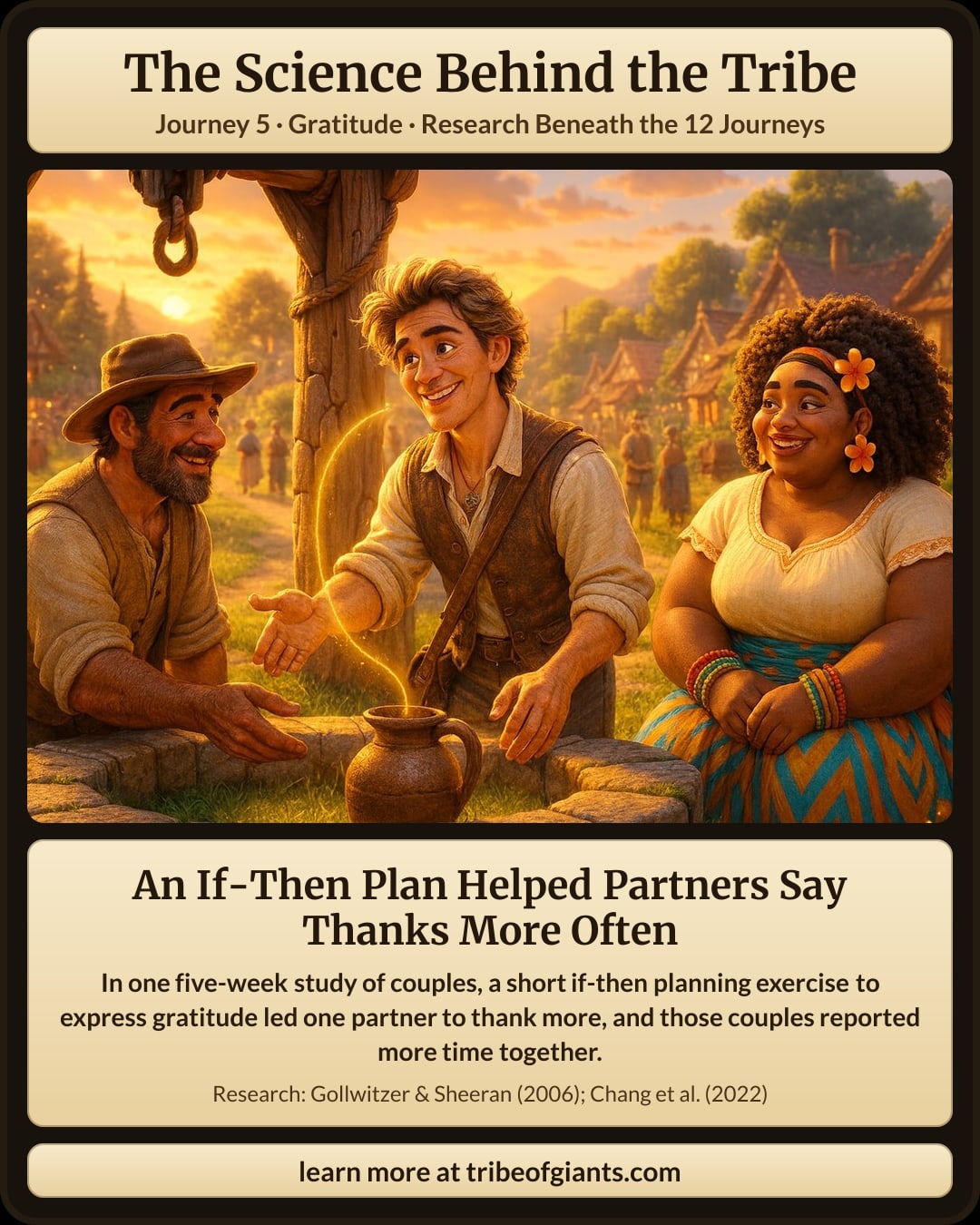
An If-Then Plan Helped Partners Say Thanks More Often
In one five-week study of couples, a short if-then planning exercise to express gratitude led one partner to thank more, and those couples reported more time together.
An if-then plan ties an action to a cue you already meet. In a meta-analysis of 94 independent tests, plans like these had a medium-to-large average effect on reaching goals (d = .65; Gollwitzer & Sheeran, 2006). In a five-week study of 125 couples, one partner in a random half made an if-then plan to express thanks; over three weeks their thanks rose more than the other half's, and those couples reported more time together (Chang et al., 2022).
The plan gives the feeling a cue; it doesn't do the feeling for you. And this is one study, based on people's own daily reports, so it suggests thanks can be prompted more often, not that a habit turns you into a more grateful person. That step hasn't been measured for gratitude habits.
In Journey 5, Gratitude, guided by Zawadi, the last session builds this kind of plan: 'After I ___, I will ___', then weeks of repetition. What do you already do every day that could cue one honest thank-you?
The research
Growing evidence Real research that's still building — results are promising and still being tested.
- Gollwitzer, P. M., & Sheeran, P. (2006). Implementation intentions and goal achievement: A meta-analysis of effects and processes. Advances in Experimental Social Psychology, 38, 69–119.
- Chang, Y.-P., Way, B. M., Sheeran, P., Kurtz, L. E., Baucom, D. H., & Algoe, S. B. (2022). Implementation intentions to express gratitude increase daily time co-present with an intimate partner, and moderate effects of variation in CD38. Scientific Reports, 12(1), 11697.
A free account for life, with All-Access free for your first 30 days. No card.
Join free