Two People Both Say "I Need to Be More Self-Aware." They Need Two Different Guides.
The Tribe of Giants · July 21, 2026
You don't have a discipline problem. You have an identity problem.
Here's where that shows up in a place people don't expect: the vague self-diagnosis of "I need to work on my self-awareness." Two people can say that exact sentence and be describing two completely different problems — and if you hand both of them the same advice, one of them will get nothing out of it.
In the 12 Journeys, this isn't a guess. It's built into the sequence: Journey 1, Non-Consciousness, embodied by Layla, and Journey 2, Awareness, embodied by Lemeki, are two separate root journeys with two separate jobs. Most people trying to "be more self-aware" are actually stuck in one specific stage of that sequence — and the fix for each stage looks nothing alike. Here's how to tell which one is yours.
The two jobs, and why they're not the same job
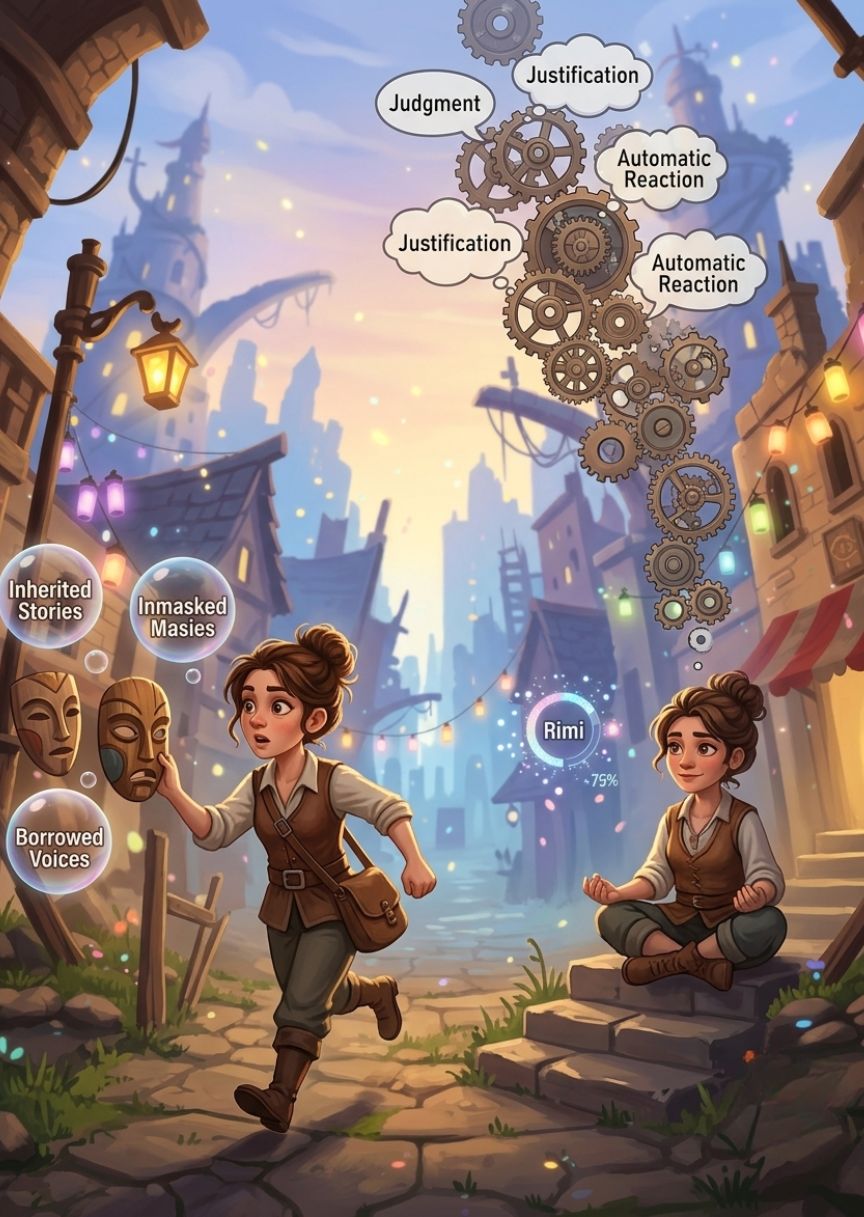
Layla's journey has a specific core message: you don't start blank — you begin shaped by inherited stories and voices, and the work is to unmask those unconscious influences so you can consciously choose who you become. Her territory is the stuff running underneath you that you haven't even clocked yet: the "Small Self" operating from "old programming" — deeply ingrained, often unconscious patterns that dictate your thoughts, feelings, and actions, shaping how you see yourself and the world like old shadows or adaptive parts built for survival.
Lemeki's journey starts from a different assumption entirely — that you've already caught the pattern. His work is about becoming conscious of the processes that operate in the background of your life, shifting from automatic reactions to mindful choices — waking up to your behaviors and becoming a conscious creator of your reality. Inside that journey, you're explicitly working with judgments, justifications, and what it means to become an observer of your own internal experience.
Notice the difference: Layla's job is detection. Lemeki's job is what you do once you've detected it. Confusing the two is why "just be more self-aware" advice so often goes nowhere — it hands Lemeki's tool (observe without judgment) to someone who's still stuck at Layla's stage (you haven't even noticed the pattern is there).
Signs you're actually stuck in Layla's stage
You're likely still working Journey 1's problem, not Journey 2's, if:
- You can describe your reaction after the fact, but you never catch it while it's happening — it's always a surprise, every time.
- When you try to find the pattern, you draw a blank. Nothing surfaces except a vague sense that "something's off."
- You notice the physical signal — tension, a flush of heat, a pulled-back posture — but you can't yet connect it to anything you'd call a pattern, a voice, or an old story.
- Your explanations for your own behavior sound borrowed — like something someone else once said about you, not something you arrived at yourself.
If that's you, the work isn't to observe more calmly. It's to unmask the inherited story first — Layla's job — before there's anything for Lemeki to help you sit with.
Signs you're actually stuck in Lemeki's stage
You've moved past detection and you're stuck in Journey 2's problem if:
- You can name the pattern instantly — "there's my old programming" — but naming it doesn't stop you from acting on it anyway.
- The moment you notice a reaction, you're immediately building a case for why it was justified, rather than just watching it.
- You judge yourself for having the pattern at all, which becomes its own reaction to manage — judgment layered on judgment.
- You know exactly what you're supposed to do differently, and still find yourself making the automatic choice instead of the mindful one.
If that's you, more detection won't help — you've already got it. What you're missing is Lemeki's actual move: becoming the observer of the judgment and the justification, instead of running on them.
Why you can't shortcut to Lemeki's stage
The framework treats this as a real sequence, not a preference. Non-consciousness naturally comes first and leads to awareness, which then makes emotional processing and healing possible in later journeys. Awareness is described as implicitly involved in every subsequent journey — insight is what makes progress in any of them possible — and it's something you're meant to revisit when old behaviors resurface, since that return is what allows for course correction and continued growth. In practice: if Lemeki's tools aren't landing, the honest move is to go back and check whether Layla's job is actually done, not to try harder at observing.
What the guide points to as backing
The Journey of Awareness guide names its own research lineage rather than leaving the claim to float. It cites Daniel Kahneman's distinction between fast, automatic thinking and slow, deliberate thinking as the basis for why catching a fast reaction matters before you can choose a slower one. It also cites William James's idea of the "stream of consciousness" — the continuous flow of mental life, much of which occurs below conscious awareness and shapes perceptions and actions without deliberate intent — as further grounding for why so much of what drives a reaction never announces itself directly. Both are the guide's own cited support for the Layla-then-Lemeki sequence, not a separate claim being made here.
Running the diagnostic with Rimi
This isn't a one-time quiz. The honest version of it is checking, in the moment a pattern shows up, whether you're still at "I don't even see it" or already at "I see it and can't stop acting on it." That's the ongoing work Rimi, your AI guide inside the Tribe of Giants, is built for — daily check-ins and teach-back mastery checkpoints that push you to actually demonstrate you've moved from Layla's stage into Lemeki's, not just tell yourself you have. As Rimi puts it: "I'll teach you what I know—but becoming a Giant is up to you." The check-ins surface whether the pattern is caught; the teach-back checkpoints surface whether you can actually work with it once caught — which is exactly the Layla-to-Lemeki line this piece is about.
Where to start
Joining the Tribe is free, $0, no credit card required, and it includes your first journey — Layla's Journey of Non-Consciousness — free. Journeys 2 through 12, including Lemeki's Journey of Awareness, plus Rimi's daily check-ins and teach-back checkpoints, unlock with All-Access at $49/month, and you can cancel anytime. If you want to do this work live, the same transformation is available through SUM GIGANTE training or one-on-one coaching for $997.
You don't have a discipline problem. You have an identity problem. Run the diagnostic honestly, and you'll know which guide to start with.